Tuesday, March 18, 2025

Canadian Association of Law Libraries Webinar on Tribunals for Access to Justice in Canada

The Canadian Association of Law Libraries (CALL) is hosting a webinar on April 2, 2005 from 12 to 1PM EST on Tribunals for Access to Justice in Canada: The Good, the Bad, and the Ugly:

"Canada’s tribunals resolve many of the most important and frequently-arising legal disputes, within specialized spheres of jurisdiction assigned by statutes.  Their potential to outperform courts in delivering speedy and accessible justice has long been recognized, and in many cases that potential is realized.  However, some Canadian tribunals today (especially Ontario’s high-volume tribunals) are afflicted by politicization, delay, and endemic miscarriages of procedural and substantive justice.  This discussion will explore tribunals’ promise as a path toward more accessible justice, as well as the pitfalls on this road."

"In this session, Professor Noel Semple will update CALL/ACBD members on recent research and observations about the significant delays facing litigants at a number of Ontario Tribunals. The session will raise awareness of the importance of tribunals in our justice system, the impacts on litigants, policy and political influences leading to this situation, and the implications on access to justice."

The speaker is Noel Semple, Associate Professor, University of Windsor Faculty of Law.


Labels: , ,

Bookmark and Share Subscribe
posted by Michel-Adrien at 5:39 pm 0 comments

Wednesday, December 18, 2024

Canadian Forum on Civil Justice Winter 2024 Newsletter

The non-profit Canadian Forum on Access to Justice (CFCJ) publishes a regular newsletter on access to justice issues.


The latest issue includes:

  • a report on access to justice through the tribunal system
  • a visual explainer on multi-disciplinary legal problem resolution
  • a roundup of the most read CFCJ publications from 2024
  • news about the Organization for Economic Cooperation and Development Roundtable on Equal Access to Justice held recently in Ottawa
  • and more
The CFCJ is a national non-profit organization that works to advance civil justice reform through research and advocacy.

Labels:

Bookmark and Share Subscribe
posted by Michel-Adrien at 6:47 pm 0 comments

Tuesday, October 29, 2024

Delays in the Justice System and the Rise of Vigilantism

Slaw.ca recently published an article on he Breakdown of Trust: How Delays in Canada’s Justice System Foster Vigilantism.

It is written by Travis Dods of the Canadian Forum on Civil Justice (CFCJ):

"The Canadian justice system has long grappled with delays, but recent figures underscore a crisis of unprecedented proportions (...) As an example, data from the post-pandemic Tribunals Ontario 2021-22 Annual Report revealed that the four largest tribunals in Ontario ... were burdened with a collective backlog of over 67,000 cases."

"This staggering number translates to real, life-changing consequences for individuals awaiting justice. Parties face extended trauma, enduring persistent anxiety as they seek closure on some of the most distressing experiences they likely have ever encountered. More broadly, these delays undermine the public’s confidence in the justice system."

"The frustration stemming from the principle of 'justice delayed is justice denied' has led to real-world consequences, with individuals abandoning the justice system and turning to extralegal means to resolve their disputes. For instance, in response to growing backlogs at the Landlord and Tenant Board, legal clinics have reported a rise in 'self-help' methods used by landlords and tenants, such as illegal lock changes or withholding rent. While these actions may sometimes be understandable given the circumstances, they reflect a troubling shift away from formal legal processes toward a preference for immediate, and often unlawful, resolutions. Perhaps the most alarming of these extralegal methods is vigilantism."

The article explores examples of vigilantism from Canadian history and proposes avenues for restoring faith in the system.

The CFCJ is a national non-profit organization that works to advance civil justice reform through research and advocacy.

Labels: ,

Bookmark and Share Subscribe
posted by Michel-Adrien at 7:59 pm 0 comments

Monday, August 19, 2024

Video Recording of CALL Conference Session on Legal Information for Incarcerated Persons

At the recent annual conference of the Canadian Association of Law Libraries in late June in Montreal, panelists and advocates from across the country took part in a panel discussion on access to libraries, law, and legal information for incarcerated persons. 

The session is now available on YouTube.

"Prison libraries are fundamental as they provide access to information about the rights of the incarcerated person and the tools necessary to access those rights. Imprisoned Canadians are an underserved segment of the population who lack adequate access to legal information and library services. Most provincial prisons do not have formal libraries. Without a legislated requirement for library access to books and materials, incarcerated persons lack recreational, cultural, educational, and law reading materials. As more legal information is placed online, incarcerated persons are being excluded from simple access to the law. The 'language of law' is not available to this group."

Panelists included:

  • Helen Anderson, Director, CLEO Connect
  • Alan Kilpatrick, Law Society of Saskatchewan
  • Romy Otayek, Centre hospitalier de l'Université de Montréal
  • The Honourable Kim Pate, Senate of Canada
  • Karen Sawatzky, Manitoba Law Library
  • Ava Sinclair, Buffalo Sage Wellness House
  • Kirsten Wurmann, Manitoba Library Association

Labels: , , ,

Bookmark and Share Subscribe
posted by Michel-Adrien at 6:18 pm 0 comments

Monday, July 22, 2024

Canadian Forum on Civil Justice Summer 2024 Newsletter

The non-profit Canadian Forum on Access to Justice (CFCJ) publishes a regular newsletter on access to justice issues.

The latest issue includes news about:

  • access to justice initiatives in rural areas;
  • innovation in community legal clinics in Ontario;
  • legal challenges faced by migrant caregivers;
  • and lots more
The CFCJ is a national non-profit organization that works to advance civil justice reform through research and advocacy.

Labels:

Bookmark and Share Subscribe
posted by Michel-Adrien at 12:54 pm 0 comments

Wednesday, July 10, 2024

July/August 2024 Issue of AALL Spectrum

The July/August 2024 issue of AALL Spectrum is now available online.

It is a publication of the American Association of Law Libraries.

This issue has a particular focus on advancing access to justice.

Labels: , ,

Bookmark and Share Subscribe
posted by Michel-Adrien at 7:20 pm 0 comments

Thursday, July 04, 2024

Progress Report from the Action Committee on Modernizing Court Operations

The Action Committee on Modernizing Court Operations, a body that provides guidance to modernize Canadian court operations and improve access to justice, has released its 2023-2024 Progress Report:

"Its work targets all levels of Canadian courts, in all types of court matters, including criminal, civil and family. The Action Committee also acts as a hub for information sharing, coordination and collaboration among judicial and justice partners who work in court operations across the country. Additionally, it identifies areas of further study that may interest policymakers, academics, and training providers in the field of court operations."

The report some of the Committee's latest work in areas such as:

  • improving court operations for Indigenous court users
  • increasing access to justice for court users
  • guidance focusing on virtual and hybrid hearings in family matters
  • supporting emergency preparedness so Canadian courts can face the challenges of pandemics, severe weather, and wildfires
Membership of the Committee includes the Chief Justice of Canada, senior judges from many provinces, and provincial ministers.


Labels: , ,

Bookmark and Share Subscribe
posted by Michel-Adrien at 5:59 pm 0 comments

Thursday, April 04, 2024

Most Recent Intake Report on Canadian Self-Represented Litigants

The National Self-Represented Litigants Project (NSRLP)  conducts research into access to justice issues, in particular those concerning people who cannot afford a lawyer and must represent themselves ("self-reps")

Every few years, it produces a report based on demographic data it has collected from self-reps.

The 2021-2023 Self-Represented Litigant Intake Report is now available.


The report includes demographic data, describes what kinds of legal help people are seeking as well as the barriers they face when trying to access justice.

The NSRLP is funded by the Law Foundation of Ontario and the University of Windsor, Faculty of Law.


Labels:

Bookmark and Share Subscribe
posted by Michel-Adrien at 8:28 pm 0 comments

Sunday, February 18, 2024

Courthouse Libraries BC Provides Free Access to Docket Information

Courthouse Libraries BC, the network of public law libraries in 30 courthouses around the province of British Columbia, is now providing free access to the province's court records system in its various locations.

Known as Court Services Online, the system provides access to provincial and BC Supreme Court civil files:

"We’ve secured special access to BC’s Court Services Online’s (CSO) E-search for all visitors to our library branches. This access is not just a new service—it’s a bridge to understanding the intricacies of legal proceedings, offering unparalleled insight into court cases within the limits of court records access policies."

"What is CSO E-search and Why Does It Matter?"

"CSO E-search is an online portal that allows users to search and view docket information for BC court cases. It’s an essential tool for anyone needing detailed information about legal precedents, court procedures, and the progress of specific cases. Until now, access was restricted by a pay-wall, making it challenging for the general public and even some legal professionals to obtain the information they needed without economic barriers."

"This special arrangement with CSO E-search opens up numerous possibilities for legal research, education, and preparation."

Labels: , ,

Bookmark and Share Subscribe
posted by Michel-Adrien at 11:38 am 0 comments

Wednesday, January 31, 2024

2023 Corruption Perceptions Index

The government ethics watchdog group Transparency International has released its 2023 Corruption Perceptions Index (CPI), a survey of perceptions of corruption in hundreds of countries across the globe.

180 countries and territories are ranked by their perceived levels of public sector corruption. The scores range from zero (highly corrupt) to 100 (very clean).


More than two-thirds of the countries and territories fell below 50. Most countries have either declined or made no progress in the last decade. 

Rising authoritarianism and the undermining of independent accountability mechanisms and independent justice systems are to blame according to the NGO:

"Justice and the effective rule of law are essential for preventing and stopping corruption at  both the national and international levels. Both are cornerstones of democracy and  embody notions of fairness and accountability. Impunity for corruption – where people who abuse their power do not face consequences for the harm they cause – is the essence of  injustice and failure of the rule of law." 

"There has been a global decline in justice and the rule of law since 2016.  The rise of authoritarianism in some countries contributes to this trend, and even in democratic contexts, the mechanisms that keep governments in check have weakened. Governments across the political spectrum have undermined justice systems, restricted civic freedoms  and relied on non-democratic strategies to address recent challenges, including the COVID-19 pandemic."

"Against this backdrop, this year’s Corruption Perceptions Index (CPI) shows that only 28 of the 180 countries measured by this index have improved their corruption levels over the last twelve years, and 34 countries have significantly worsened. Despite progress made across the planet in criminalising corruption and establishing specialised institutions to address it, corruption levels remain stagnant globally."

The least corrupt countries in descending order according to the Index are Denmark, Finland , New Zealand, Norway, Singapore, Sweden, and Switzerland.

At the other end of the listing, the most corrupt countries are estimated to be Somalia, South Sudan, Syria, Venezuela, Yemen, Equatorial Guinea, Haiti, North Korea, and Nicaragua.

The Index aggregates data from several different sources to gather perceptions among businesspeople and country experts of the level of corruption in the public sector. 


Labels: , , , ,

Bookmark and Share Subscribe
posted by Michel-Adrien at 8:06 pm 0 comments

Thursday, December 21, 2023

Canadian Forum on Civil Justice Winter 2023 Newsletter

The non-profit Canadian Forum on Access to Justice (CFCJ) publishes a regular newsletter on access to justice issues.

The latest issue includes news about:

  • the role of legal clinics
  • a newly revised Selected Annotated Bibliography of National and Regional Legal Needs Surveys
  • CFCJ resources and reports
  • and much more
The CFCJ is a national non-profit organization that works to advance civil justice reform through research and advocacy.

Labels:

Bookmark and Share Subscribe
posted by Michel-Adrien at 9:14 pm 0 comments

Tuesday, December 12, 2023

Presentations of the Ontario Access to Justice Week 2023 Available Online

The Action Group on Access to Justice (TAG) was established by the Law Society of Ontario in 2015 to bring together justice stakeholders to develop public-centred solutions.

One of its activities is Access to Justice Week whose 2023 edition took place from October 23 to 27, 2023.

Many of the sessions were recorded and are now available for free online.


Labels: ,

Bookmark and Share Subscribe
posted by Michel-Adrien at 8:06 pm 0 comments

Thursday, September 07, 2023

British Columbia Newsletter About Unbundling Legal Services

Slaw.ca today published an article about the BC Family Justice Innovation Lab in British Columbia.

A major focus of the lab is the "unbundling" of legal services.

The concept describes a situation where a client hires a lawyer or paralegal to complete specific discrete tasks, the client handling the rest of the legal problem.

The client is charged only for those tasks agreed to in advance, unlike in the traditional full-representation model.

For example, a client opting for an out-of-court process like mediation would contract with a lawyer for legal advice before mediation or for the drafting of a binding agreement after mediation. 

Unbundling is proving to be popular and a more affordable avenue for many people.

The Lab also publishes a newsletter.


Labels:

Bookmark and Share Subscribe
posted by Michel-Adrien at 7:01 pm 0 comments

Tuesday, August 22, 2023

Article on Legal Needs Research in Canada

Lisa Moore, the director of the Canadian Forum on Civil Justice, has written an article on Slaw.ca that argues for the need for more empirical research into Canadians' legal needs. This is research into people’s legal problem experiences, as well into their engagement with the formal and informal legal systems:

"To date there have been five national legal needs surveys in Canada. The first survey, almost 20 years ago, includes responses from more than 4,500 low- and moderate-income Canadians related to 15 legal problem categories and 76 specific problems (...)  Most recently–in 2021– Statistics Canada engaged the largest number of respondents of Canada’s national legal needs surveys, with a sample size of 21,720 adults across the 10 provinces."

"Each survey builds on the previous version, with new legal problem categories, more modern data collection methods (landline only, landline and cell phone and, recently, online and telephone) and problem types and questions that reflect shifting understandings of complex legal problems and access to justice. Nonetheless, this collection of surveys, spanning almost 20 years and following a similar legal needs research survey design, represents one of Canada’s most robust exercises in longitudinal socio-legal research. These surveys provide evidence of changes in Canada’s legal problems landscape over time and identify areas where justice gaps persist. 'You can’t improve what you don’t measure,' and if we are to achieve equal access to justice for all, it is necessary to have an evidence base from which to understand the extent of our justice problems and, further, research that provides detailed insights on our progress, or decline."


Labels:

Bookmark and Share Subscribe
posted by Michel-Adrien at 8:25 pm 0 comments

Tuesday, August 08, 2023

Canadian Forum on Civil Justice Summer 2023 Newsletter

The non-profit Canadian Forum on Access to Justice (CFCJ) publishes a regular newsletter on access to justice issues.


The latest issue includes news about:

  • access to justice in rural areas
  • the recent World Justice Project that offers country-level analysis of access to justice issues
  • and more

The CFCJ is a national non-profit organization that works to advance civil justice reform through research and advocacy.

Labels:

Bookmark and Share Subscribe
posted by Michel-Adrien at 8:16 pm 0 comments

Tuesday, July 18, 2023

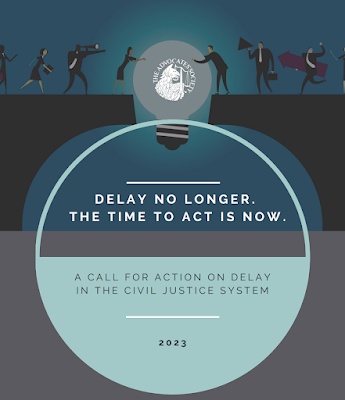
Advocates Society Report on Alarming Civil and Family Court Delays Across Canada

In late June, the Advocates Society published its report Delay No Longer. The Time to Act Is Now calling on the federal, provincial, and territorial governments to dedicate resources to the civil and family justice courts to tackle delays that are undermining faith in the justice system.

The report describes the severe impacts that delays are already having on real people and businesses who need help resolving their disputes.

The document gives a few examples:

  • In Quebec, it was estimated that in 2021-2022, litigants would wait an average of 593 days between the filing of their claim in the Small Claims Division (for claims of less than $15,000) and trial.
  • In British Columbia in 2022, the Supreme Court “bumped” (i.e. delayed hearings because of the lack of judicial resources) 10.9% of all long chambers applications, 24.6% of civil trials (102 bumped compared to 312 heard) and 14.4% of family trials (26 bumped compared to 154 heard).
  • In Alberta, it routinely takes more than 9 months for an application longer than 20 minutes to be heard by a judge in Edmonton or Calgary; and 2 to 3 years for a trial longer than 5 days to be scheduled from the date the parties certify readiness. 
  • In Ontario, it currently takes almost 1.5 years for a motion longer than 2 hours to be heard by a judge in Toronto; more than 1.5 years after the trial management conference (or more than 4 to 5 years from the issuance of the original application) for a 3-week family law trial to be heard by a judge in Brampton; and more than 4 to 5 years for a civil action to proceed from commencement to trial. 
The Society proposes more than a piecemeal approach to resolve the problem. It calls for a coordinated plan of action, including:
  • measuring delay and setting targets;
  • increasing resources for the justice system and deploying those resources flexibly with the use of technology;
  • improving the use of technology, especially to schedule court hearings; and
  • reviewing procedural rules that pose roadblocks to speedy justice.

Labels: ,

Bookmark and Share Subscribe
posted by Michel-Adrien at 7:53 pm 0 comments

Monday, July 17, 2023

Law Reform Commission of Ireland Consultation Paper on Third-Party Litigation Funding

The Law Reform Commission of Ireland has published a consultation paper on the issue of Third-Party Litigation Funding. The concept refers to investment by non-parties in dispute resolution.


From the executive summary:

"In Persona Digital Telephony Ltd v Minister for Public Enterprise, the Supreme Court confirmed that the torts and offences of maintenance and champerty remain part of Irish law. These ancient legal concepts prohibit, in most cases, the funding of litigation by third parties. One of the effects of these torts and offences is to make third-party funding (investment by non-parties in dispute resolution), subject to certain recognised exceptions, illegal in this jurisdiction. In SPV Osus Ltd v HSBC Institutional Trust Services (Ireland) Ltd, the Supreme Court held that maintenance and champerty also prohibit the assignment of a “bare” cause of action, that is, the transfer of the right to litigate a claim to a party who has no direct interest in that claim."

"As part of its Fourth Programme of Law Reform, in 2016 the Commission published an Issues Paper on Contempt of Court and Other Offences and Torts Involving the Administration of Justice. This sought submissions on whether the torts and offences of maintenance and champerty should be abolished, whether third-party funding should be permitted and how, if legalised, third party funding should be regulated. Only two submissions were received on these issues."

"Since publication of the Issues Paper, the legal and policy context for thirdparty funding has shifted considerably. The Commission therefore concluded that it was appropriate to publish a detailed Consultation Paper, setting out the up-to-date position in respect of the legalisation and regulation of thirdparty funding in Ireland and seeking further views. In addition, the issue of assignment of actions should be taken into account. The Commission has generally refrained from expressing even preliminary or provisional views on the issues discussed in this Consultation Paper. Its purpose is to inform debate and stimulate discussion which, it is hoped, will generate responses from all interests and perspectives that will enable the Commission to move to a final report setting out its recommendations."


Labels: , , ,

Bookmark and Share Subscribe
posted by Michel-Adrien at 7:07 pm 0 comments

Thursday, April 27, 2023

Geek in Review Podcast Interview on the Impact of CaseText’s CoCounsel on Law and Technology

The most recent episode of the Geek in Review Podcast co-hosted by Greg Lambert and Marlene Gebauer is available.

Lambert is a former president of the American Association of Law Libraries.

The podcast features a discussion with legal technology experts ⁠Pablo Arredondo⁠, ⁠Evan Shenkman⁠, and ⁠Darth Vaughn⁠:

"They discuss their proactive approach to incorporating AI technology, specifically ⁠CaseText’s CoCounsel⁠, into their legal practice and business operations."

"Pablo shares, 'I think the law is such a fascinating space for this kind of AI because it really brings together two things that are really deep in the human experience, which is language and rules.' The guests discuss their experiences in using CoCounsel and its features, such as the ChatGPT feature, which enables them to draft and review documents more efficiently. Evan emphasizes, 'The tools are there, and the more that we can sort of get folks up to speed on this stuff, and really help them understand how to use the tools, the better we’re all going to be'." (...)

"The discussion also touches on access to justice issues and how tools like CoCounsel can potentially help bridge the justice gap. By being intentional in utilizing AI technology to assist in pro bono cases, they believe it is possible to make a significant impact on improving access to legal services for those in need."


Labels: , , ,

Bookmark and Share Subscribe
posted by Michel-Adrien at 4:25 pm 0 comments

Sunday, March 05, 2023

Recent Justice-Related Documents from the Government of Canada

The Government of Canada's Weekly Acquisitions List can be a great way to discover new research reports published by various public bodies and agencies of the federal government. It is a record of all publications catalogued in the previous week.

Here are a few recent additions of justice-related documents:

  • The Voice of the Child in Family Law: Exploring Strategies, Challenges, and Best Practices for Canada (original publication date 2019): "The objective of this project is to collect and collate research, describe existing methods to include the children’s voices in family law in Canada (and internationally where relevant), to identify themes, and to develop a comprehensive and accessible literature review. This review provides descriptions of promising practices applicable to various aspects of the voice of the child and discussions of case law."
  • Victims’ Rights in Canada in the 21st Century (written in 2021): "This report will not revisit the well-known territory of theory and philosophy in any significant manner; however, Part I of this report will still explore the relationship between theory and practical change in order to provide some context and framework for the remainder of the report. Part II will explore any significant changes, and the studies which have evaluated these changes, with respect to the rights of victims to participate at trial in the past twenty years and with respect to statutory provisions designed to protect the privacy and dignity of the victim as a witness at trial. Parts III and IV will present similar, but briefer, explorations with respect to the welfare rights or entitlements of victims, as well as developments relating to restorative justice."
  • Victim Privacy and Open Justice: 2.0 At the Frontiers of Change (written in 2020): "The purpose of this report, commissioned by the Research and Statistics Division of the Department of Justice, is to review and update changes to open court and victim privacy principle since 2003, which was the year that Victim Privacy and the Open Court Principle report was written (hereinafter referred to as the 2003 Report). This update maintains symmetry with the structure of the 2003 Report in its review of Supreme Court of Canada jurisprudence and legislative changes since then. By 2003, the Supreme Court strongly endorsed and protected open court, adopting a strong standard of justification that required a sound evidentiary basis to warrant limits to the principle. The “second generation” jurisprudence is consistent with that conception of openness, but notable for accepting restrictions more readily and, in some instances, explicitly on grounds of a victim or participant’s vulnerability (...) The update would not be complete without discussion of two “frontier” developments: the impact of technology, and transformation of public and cultural discourse about sexual offending. First, the challenges to openness posed by technology are briefly identified and analyzed: this includes electronic court records and documents, the electronic courtroom, as well as electronic publicity and publication bans (...) Second, unexpected and major shifts in the narrative of sexual transgression represent a gamechanging development for victims of such offences and their role in the criminal justice system, including their privacy interests. Frustration with the typical justice system response to sexual assault have led some advocates to lobby for changes within the criminal justice system and sanctions that may fall outside the formal justice system. One of the more obvious and interesting points about the three watershed events discussed – #BeenRapedNeverReported, Unfounded, #MeToo – is that the transformation in discourse is for the most part driven by forces connected to, but outside the formal processes of law. Social media activism and investigative journalism have been at the forefront of change. Through the momentum of these broad-based movements, the social, psychological and cultural environment of sexual transgression has undergone fundamental change, with positive results for the reporting of offences, their handling by Canadian police forces, and victim perceptions of their status in criminal justice and willingness to step forward on their own and in solidarity with others, whether anonymously or not. "
  • Review of International Child Support Models Volume I – Main Report (written in 2019): "As part of ongoing legal policy work, the Department of Justice Canada contracted with Kelly Sears Consulting Group to conduct an extensive review of international models used to determine child support amounts. The overall purpose of the research was to review and analyze child  support models with a focus on how selected issues are addressed. The jurisdictions included in this study were: the United Kingdom, Australia, France, Norway, Sweden, New Zealand, and the American states of Wisconsin, Delaware, Illinois, and Vermont. "
  • Review of International Child Support Models Volume II – Jurisdictional Summaries

Labels: , , , , , , , , ,

Bookmark and Share Subscribe
posted by Michel-Adrien at 7:55 pm 0 comments

Thursday, January 19, 2023

Canadian Forum on Civil Justice Winter 2022 Newsletter

The non-profit Canadian Forum on Access to Justice (CFCJ) publishes a regular newsletter on access to justice issues.

The latest issue includes news about:

  • an upcoming Indigenous Access to Civil Justice Conference
  • a new project about access to justice via administrative tribunals and panels
  • the Accessibility for Ontarians with Disabilities Act
  • and more

The CFCJ is a national non-profit organization that works to advance civil justice reform through research and advocacy. 

Labels: , , ,

Bookmark and Share Subscribe
posted by Michel-Adrien at 8:11 pm 0 comments