Wednesday, March 06, 2024

Alberta Law Reform Institute Report on Alteration and Revocation of Electronic Wills

The Alberta Law Reform Institute (ALRI) has published its final report on the Alteration and Revocation of Electronic Wills.

This comes as a companion to the ALRI's 2023 report on the Creation of Electronic Wills.

"ALRI recommends that the alteration and revocation of electronic wills should be governed largely by the same rules currently found in Alberta’s Wills and Succession Act (“WSA”), with additional witness requirements for certain acts of revocation (...)"

"What is the problem?
Testators should be able to change or alter their electronic will after it has been created. Similarly, testators should be able to revoke an electronic will. However, electronic wills present a unique challenge. Unlike a pen mark on a paper will, it is harder to identify when an electronic will has been altered or revoked by a key stroke. It is also harder to identify whether or not the person making the changes actually intended them to alter or revoke their electronic will. To ensure the law properly supports people changing or revoking electronic wills, these issues must be adequately addressed. Additionally, the rules surrounding electronic wills should reflect the expectations of testators to ensure that the probate system continues to function justly and efficiently."

"Legal Research
ALRI conducted in-depth legal research for this project. That research included a review of the current wills law in Alberta, and comparative research with other jurisdictions. The review of Alberta law provided ALRI with a background on the formalities required to alter or revoke a paper will under the WSA, and the purposes those formalities serve. ALRI’s comparative research provided insight into how other jurisdictions have adopted formalities for the alteration or revocation of electronic wills that continue to serve these same four purposes. In both circumstances, the formalities for the alteration or revocation of a will are intended to:

  • protect testators and their estates,
  • provide evidence of testamentary intention,
  • channel estates through probate justly and efficiently, and
  • provide a sense of ritual to highlight the importance of changing or revoking a will."

Labels: , ,

Bookmark and Share Subscribe
posted by Michel-Adrien at 8:06 pm 0 comments

Thursday, October 19, 2023

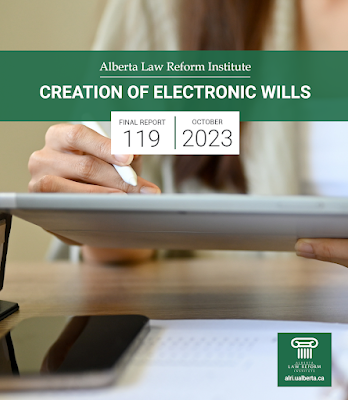
Alberta Law Reform Institute Report on Electronic Wills

The Alberta Law Reform Institute (ALRI) has published its final report on the Creation of Electronic Wills:

"ALRI conducted extensive consultations with the public and estate planning professionals to assess what people expected from the law when making their will. ALRI heard from over 400 members of the public and held in-depth roundtable consultations with trusted estate planning practitioners from across the province. Our consultation results confirm that people want to be able to create wills using electronic tools."

"ALRI recommends that electronic wills should be permitted in Alberta. The formalities for electronic wills should mirror the formalities for paper wills, but they should be accomplished in electronic form. In other words, electronic wills should be:

  • Readable as electronic text,
  • Signed by the testator, using an electronic signature, and,
  • Signed by two witnesses, who are both present at the same time, using an electronic signature."

"Final Report 119 also makes recommendations regarding remote witnessing, electronic holograph wills, video formats and the dispensing power. These recommendations aim to bring certainty, predictability, and accessibility to the law, while embracing technological advancements and maintaining the integrity and security of the testamentary process."

Labels: , ,

Bookmark and Share Subscribe
posted by Michel-Adrien at 8:06 pm 0 comments

Thursday, February 03, 2022

Alberta Law Reform Institute Report on Family Maintenance and Support from the Estate of a Person Who Stood in the Place of a Parent

 The Alberta Law Reform Institute recently released a report on Family Maintenance and Support from the Estate of a Person Who Stood in the Place of a Parent:

"Family Maintenance and Support from the Estate of a Person Who Stood in the Place of a Parent, Final Report 117 recommends that the Wills and Succession Act be reformed to allow a child to apply for family maintenance and support from the estate of a person who stood in the place of a parent (...)"

"This recommendation would close a gap in the law about child support. A child may apply for support from a person standing in the place of a parent while the person is alive, but not after the person’s death. ALRI has concluded that children should be able to apply for support in both situations. ALRI recommendations are based on widespread consultation including three online surveys targeted at the general public ..."

"ALRI’s recommendations would make the Wills and Succession Act consistent with other provincial legislation that provides benefits to a child with a person standing in the place of a parent, like the Family Law Act, the Fatal Accidents Act, and the Workers’ Compensation Act."

Labels: , , ,

Bookmark and Share Subscribe
posted by Michel-Adrien at 5:55 pm 0 comments

Sunday, January 31, 2021

Manitoba Law Reform Commission Final Report on What To Do About Unclaimed Accounts

The Manitoba Law Reform Commission has released its final report on Abandoned Accounts and Missing Money: Establishing a Process for Unclaimed Intangible Personal Property.

The report makes recommendations about how to handle abandoned or forgotten personal property such as credit balances, insurance policies, bonds or pension plans. This often happens when a person dies intestate:

"In Manitoba there is no obligation on the part of many property holders, such as credit unions and insurance policy holders, to report unclaimed personal property to the provincial government. Even where unclaimed personal property is remitted to holders and the government, the legislation provides no guidance for an individual to find out if they are the rightful owner and to apply to claim the money if they establish that they are the rightful owner. Other Canadian jurisdictions have enacted legislation to address unclaimed property so that money can end up in the hands of rightful owners. In light of reforms in other Canadian jurisdictions, the Commission has considered the question: Should Manitoba adopt a process for unclaimed intangible personal property? If so, what elements would the legislation need to address?"

"This project involves two distinct, yet related, issues: escheats and unclaimed property. While distinct legal concepts, in both cases the property vests in the Crown by operation of law. In Manitoba, both these situations are addressed in the same piece of legislation, The Escheats Act. The full version of this Act can be found at Appendix B."

"The Commission has learned that the process for administering escheats and unclaimed property is cumbersome for the government and impractical for individuals seeking to claim vacant or unclaimed property. Other jurisdictions, such as British Columbia, Alberta, Quebec, Ontario and New Brunswick, have introduced changes to modernize and improve legislation related to property that vests in the Crown."

The Commission is recommending that Manitoba enact legislation similar to other provinces.

Labels: , , ,

Bookmark and Share Subscribe
posted by Michel-Adrien at 8:10 pm 0 comments

Tuesday, March 31, 2020

Manitoba Law Reform Commission Final Report on Wills Act

Last week, the Manitoba Law Reform Commission released its Final Report titled Reform of The Wills Act, The Law of Property Act, And The Beneficiary Designation Act, Revisited:
"In this report, the Commission revisits the recommendations for reform of The Wills Act and related legislation first considered in its 2003 report, Wills and Succession Legislation ... Recommendations for substantial reform reiterated in this report include reducing the age by which a person can make a valid will from 18 to 16 years and introducing into the legislation a definition of an electronic will."

"Other recommendations contained in Report 108 have been reversed either due to advancements in the case law in a given area, recent trends in legislative reform in other jurisdictions or based on feedback received during the consultations. For example, given the enhanced focus on predatory marriages and resulting reforms in other jurisdictions, the Commission is now recommending the abolishment of the automatic revocation of a will by a subsequent marriage."

"Finally, this report contains a number of new recommendations not contained in Report 108, including amending the Court of Queen’s Bench Rules to enable the court to make, alter, or revoke a will for a person lacking testamentary mental capacity."

"The Recommendations contained in this report seek to improve and modernize the legislation and to help Manitobans carry out their testamentary intentions."
The recommendations cover a range of issues, including mental capacity, minors, electronic wills, revocation, undue influence and more.

The report also makes extensive reference to the situation in other Canadian provinces, as well as in the United Kingdom, Australia and New Zealand.

Labels: , , ,

Bookmark and Share Subscribe
posted by Michel-Adrien at 8:29 pm 0 comments

Tuesday, October 29, 2019

Manitoba Law Reform Commission Consultation on Abandoned Accounts and Missing Money: Establishing a Process for Unclaimed Intangible Personal Property

The Manitoba Law Reform Commission has published a consultation report entitled Abandoned Accounts and Missing Money: Establishing a Process for Unclaimed Intangible Personal Property.

It looks at what happens to unclaimed personal property in Manitoba, such as abandoned or forgotten credit balances, insurance policies, bonds or pension plans:
"In Manitoba there is no obligation on the part of many property holders, such as credit unions and insurance policy holders, to report unclaimed personal property to the provincial government. Even where unclaimed personal property is remitted to the government the legislation provides no guidance for an individual to find out if they are the rightful owner. Other Canadian jurisdictions have enacted legislation to address unclaimed property so that money can end up in the hands of rightful owners. In light of reforms in other Canadian jurisdictions, the Commission asks the question: Should Manitoba adopt a process for unclaimed intangible personal property? If so, what elements would the legislation need to address?"

"This project involves two distinct, yet related, issues: escheats and unclaimed property. While distinct legal concepts, in both cases the property vests in the Crown by operation of law. In Manitoba, both these situations are addressed in the same piece of legislation, The Escheats Act. The Commission has learned that the process for administering escheats and unclaimed property is cumbersome for the government and impractical for individuals seeking to claim vacant or unclaimed property. Other jurisdictions, such as British Columbia, Alberta, Quebec, and Ontario, have introduced changes to modernize and improve legislation related to property that vests in the Crown."

"This Consultation Report invites readers to provide their comments on ten issues for discussion. The issues identified in this report require input from interested organizations and individuals so that the Commission can craft recommendations that will be practical and meaningful to those affected by any contemplated changes to the legislation.
Chapter 2 provides background on the legal origins of escheats and vacant property and describes the current law and procedure in Manitoba. Chapter 3 explores recent legislative reforms in other jurisdictions. Chapter 4 discusses possible areas of reform to Manitoba’s legal framework for escheats and unclaimed property, touching on important considerations should the  government wish to introduce a regime for unclaimed property."

Labels: , , , ,

Bookmark and Share Subscribe
posted by Michel-Adrien at 8:34 pm 0 comments

Thursday, September 19, 2019

Manitoba Law Reform Commission Consultation Report on Wills Act

The Manitoba Law Reform Commission has issued a consultation report called Reform of The Wills Act Revisited:
"In 2003, the Manitoba Law Reform Commission ... published Report 108, Wills and Succession Legislation (“Report 108”), which contains 77 recommendations to reform wills legislation in Manitoba, none of which has been implemented. Since the report’s release, several other law reform agencies have published reports on this topic and several legislative amendments have been enacted by other jurisdictions; they make timely an update of Report 108 and afford an opportunity to shine light on and affirm the recommendations and add several new recommendations."
The report examines many questions, including those relating to mental Capacity, minors, electronic wills, revocation, undue influence and more.

It also examines the situation in other Canadian provinces, as well as in England, Scotland, Australia and New Zealand.

Labels: , , ,

Bookmark and Share Subscribe
posted by Michel-Adrien at 2:36 pm 0 comments

Thursday, June 27, 2019

Nova Scotia Law Reform Institute Discussion Paper on Intestate Succession Act

The Access to Justice & Law Reform Institute of Nova Scotia has published a discussion paper on the province's Intestate Succession Act:
"This Discussion Paper considers how a deceased person’s real and personal property should be disposed of if they die without a will (otherwise known as intestacy). The Intestate Succession Act RSNS 1989, c 236 governs the disposition of these estates in Nova Scotia. While it’s underlying function remains valid, the Act no longer reflects the legal, social, and economic landscape faced by Nova Scotians today. Reforms are needed to align the law with the modern Canadian family, harmonize it with other relevant statutes, and enhance the ability of Nova Scotians to access justice (...) "

"The Discussion Paper seeks input on the following proposals to enhance individual autonomy and address the root causes of intestacy:
  • The public should be given easily accessible information on intestacy. Public legal education on the reformed Intestate Succession Act should be available to ensure Nova Scotians understand how intestate property is distributed. Updated, easy-to-understand manuals should be available to persons who are administering an intestate estate without legal representation.
  • The public should have greater access to will drafting services for persons who wish to create a will but cannot afford to hire a lawyer.
  • Lawyers should be provided with information and materials on how to support capacity when providing wills services for persons who may face challenges in their mental capacity.
  • A simplified procedure for estates valued at $50,000 or less should be available to administer modest intestate estates."
The Institute is funded by the Government of Nova Scotia, the Government of Canada, and by the Law Foundation of Nova Scotia with in kind support from the Nova Scotia Barristers’ Society and Dalhousie University.

Labels: , ,

Bookmark and Share Subscribe
posted by Michel-Adrien at 4:21 pm 0 comments

Monday, September 03, 2018

New South Wales Law Reform Commission Consultation on Digital Assets after Death

The Law Reform Commission in New South Wales, Australia has released a consultation paper on laws that affect access to a person's digital assets after they die or become incapacitated.

As a background document explains:
"In general, a person's digital property and electronic communications are referred to as 'digital assets'. These can include photographs, videos, emails, online banking accounts, cryptocurrency, domain names, blogs and online gaming accounts."

"Digital assets can have significant personal, sentimental and even financial value. Permitting access to these assets after the person's death or incapacity is therefore essential. However, family members and fiduciaries can encounter significant barriers in acquiring access, largely due to the terms of service agreements between users and service providers."

"In response to these barriers, there is an emerging trend of overseas litigation involving grieving families seeking access to their deceased relative's digital assets. Australian courts appear to have not yet considered these issues."

"The NSW Law Reform Commission has been asked to review and report on access to digital assets upon death or incapacity. Our review will consider the current state of the law, developments that have occurred in other jurisdictions, and whether NSW should enact legislation to address the difficulties in accessing the digital assets of a deceased or incapacitated person."
The consultation document looks at the situation in the United States, Canada, and the European Union.

Labels: , , , , , , ,

Bookmark and Share Subscribe
posted by Michel-Adrien at 4:44 pm 0 comments

Wednesday, April 25, 2018

Manitoba Law Reform Commission Consultation Report on The Beneficiary Designation Act

The Manitoba Law Reform Commission has published a consultation paper on The Beneficiary Designation Act (Retirement, Savings and Other Plans):
"Pension plans, insurance proceeds, and other retirement savings vehicles play an important role in the savings strategies of Canadians. As individuals pay into these plans over the years, issues arise such as: what happens when the plan owner dies? Where does the money go?"

"In Manitoba, the treatment of the proceeds of these financial products upon the death of the owner is regulated by The Insurance Act, The Pension Benefits Act and The Beneficiary Designation Act (Retirement, Savings and Other Plans) (hereinafter “The Beneficiary Designation Act”). The latter provides for designation of beneficiaries to occur without the formalities required under The Wills Act."

"Recently, a gap in The Beneficiary Designation Act came to the attention of the Commission respecting beneficiary designations when plans are renewed, replaced or converted. In these situations, a new plan is created and the old plan ceases to exist. Plan beneficiary designations do not automatically roll over and a fresh beneficiary designation must be made or, upon the death of the owner of the plan, the proceeds are payable to the plan owner’s estate. A further look at the legislation and comparison with the legislation of other jurisdictions highlighted several other potential deficiencies in Manitoba’s legislative scheme."

"This Consultation Report considers possible amendments to improve the legislation and procedure related to beneficiary designations in Manitoba. Given the popularity of pension plans, registered savings plans, and other retirement savings vehicles in the marketplace today, it is important to ensure that the legislative scheme in place provides appropriate and adequate guidance to plan owners, designated beneficiaries and the legal profession. "

Labels: , , ,

Bookmark and Share Subscribe
posted by Michel-Adrien at 6:43 pm 0 comments

Saturday, January 20, 2018

Alberta Law Reform Institute Report on Inter-provincial Recognition of Substitute Decision-Making Documents

In December 2017, the Alberta Law Reform Institute (ALRI) released a report for discussion on Inter-provincial Recognition of Substitute Decision-Making Documents.

Substitute decision-making documents (also called powers of attorney, proxies, personal directives, etc...) delegate authority to one person to act on behalf of another with respect to financial, property or legal affairs and/or personal or health care matters. But legal requirements can often differ in different jurisdictions so that documents may not be recognized outside the province in which it was made, a situation that can create problems for people who own assets in more than one jurisdiction.

In 2016, the Uniform Law Conference of Canada approved the Uniform Interjurisdictional Recognition of Substitute Decision-Making Documents Act. The Uniform Act is intended to provide harmonized rules that may be implemented across Canada.

The ALRI report reviews the Uniform Act and considers whether it is suitable for implementation in Alberta. ALRI proposes that the Uniform Act should be implemented in Alberta, with some minor adjustments.

Labels: , , , , ,

Bookmark and Share Subscribe
posted by Michel-Adrien at 5:51 pm 0 comments

Monday, September 11, 2017

Manitoba Law Reform Consultation Report on Small Estates

The Manitoba Law Reform Commission has published a Consultation Report on Updating the Administration of Small Estates as part of its Access to Justice initiative entitled "Access to Courts and Court Processes".

"In Manitoba, The Court of Queen’s Bench Surrogate Practice Act ('The Surrogate Practice Act') governs the administration of estates, whether there is a will or not. The rules in place serve to protect estates from fraud and mismanagement. The ordinary process for obtaining probate carries with it legal and administrative costs as well as time and administrative burdens. But what happens in the case of relatively small estates, where the costs associated with administering the estate may be disproportionately high compared to the value of the estate? In these cases, the estate available for distribution may be depleted. Alternatively, the personal representative for the estate may choose not to administer the estate at all"

(...)

"This Consultation Report considers possible amendments to improve the legislation and procedure related to the summary administration of small estates under The Surrogate Practice Act. The primary area addressed is whether the monetary jurisdiction should be increased."
The report looks at practices in a number of other Canadian jurisdictions, including Ontario, Saskatchewan, British Columbia and the Northwest Territories.

The comment period on this Consultation Report is open until October 30, 2017.

Labels: , ,

Bookmark and Share Subscribe
posted by Michel-Adrien at 5:20 pm 0 comments

Most Recent Issue of LawNow: Wills and Estates

The most recent issue of LawNow is available online.


The magazine is published by the Centre for Public Legal Education Alberta.

The main section contains a number of features articles on wills and estates.

The issue also has a special report on the Canadian Senate.

Labels: , , ,

Bookmark and Share Subscribe
posted by Michel-Adrien at 5:00 pm 0 comments

Wednesday, August 02, 2017

British Columbia Law Institute Blog Series on Wills

The British Columbia Law Institute (BCLI) has started a blog series on wills.

The texts will be written by Allison Curley.
The first post was published yesterday and is entitled Making Wills Half a World Over: Part One of the Wills Series.

The series will compare proposals for reform of the law of wills made last month by the Law Commission of England and Wales with the work done on the same topic by the BCLI over the past decade.

Labels: , ,

Bookmark and Share Subscribe
posted by Michel-Adrien at 4:31 pm 0 comments

Tuesday, April 25, 2017

Law Reform Commission of Saskatchewan Final Reports on Intestate Succession Act and Homesteads Act

The Law Reform Commission of Saskatchewan recently published two (2) final reports.

They are:
  • The Final Report on Reform of The Intestate Succession Act, 1996 : "The Intestate Succession Act, 1996 determines how an estate is divided when there is not a valid will, or if there is a portion of an estate remaining after a will has been completely applied. The Commission has undertaken a comprehensive review of The Intestate Succession Act, 1996. This Final Report makes several recommendations for reform based on current estate planning practices that will ensure Saskatchewan’s intestate estate distribution system remains relatively simple, certain, and efficient."
  • The Final Report on The Homesteads Act, 1989: "The Homesteads Act, 1989 protects spouses who do not own their homes against the sale, mortgaging or other disposition of the homestead by requiring the non-owning spouse to sign a consent and be examined separately from the owning spouse before such action can be taken. This Final Report considers two distinct issues: (1) whether an attorney acting under a power of attorney should be able to consent to a disposition of the homestead, and (2) whether a homestead should include mines and minerals. This Final Report recommends allowing an attorney to consent to a disposition of the homestead in place of a non-owning spouse, subject to the condition that where the attorney is the spouse of the non-owning spouse, the attorney only be able to consent to a disposition of the homestead where the non-owning spouse lacks capacity. This Final Report also recommends that The Homesteads Act, 1989 be amended to specifically exclude mines and minerals from the definition of the homestead."

Labels: , , ,

Bookmark and Share Subscribe
posted by Michel-Adrien at 9:25 pm 0 comments

Thursday, March 23, 2017

Alberta Law Reform Institute Report Recommends Abolition of Perpetuities Law

The Alberta Law Reform Institute has published a report that recommends the abolition of perpetuities law in Alberta :
"The Alberta Law Reform Institute (ALRI) recommends the abolition of perpetuities law in Alberta. Abolition has already occurred in Manitoba, Saskatchewan and Nova Scotia. Canada-wide abolition has been recommended by the Uniform Law Conference of Canada."

"The common law rule against perpetuities (RAP) originated in England in the 17th century as a way to prevent landowners from using future or contingent interests to tie up property for generations. RAP creates a perpetuity period for such interests based on the length of a life or lives in being in existence at the creation of the interest, plus 21 years. At common law, a contingent interest is void if there is any uncertainty at the outset whether it will vest within the perpetuity period. Over the centuries the courts expanded the common law RAP to apply to virtually all future or contingent interests in property, regardless of whether the interest is real, personal, legal or equitable."

"In 1972, Alberta enacted the Perpetuities Act (the Alberta Act) to reform the worst complexities and excesses of the common law RAP, based on recommendations from ALRI (...)"

"With court variation statutes governing trusts and non-trust interests available to address perpetuities issues, ALRI believes it is time to abolish the common law RAP and repeal the Alberta Act which reforms it. Other Canadian provinces have abolished perpetuities law without any apparent major problems resulting from that decision. ALRI’s consultation feedback, coming largely from the legal profession, judiciary and trusts and estates professionals, indicates majority support for abolition. While these results are not scientific, they do at least anecdotally suggest that many professionals working in the area are now comfortable with the idea of doing away with specialized perpetuities law."
The report discusses the situation in Alberta as well as the practices adopted in Manitoba, Nova Scotia, England and New Zealand.

Labels: , , , ,

Bookmark and Share Subscribe
posted by Michel-Adrien at 12:50 pm 0 comments

Monday, March 06, 2017

Alberta Law Reform Institute Report on New Trustee Act

 The Alberta Law Reform Institute recently released its final report on A New Trustee Act for Alberta:
"In 2007, the Uniform Law Conference of Canada (ULCC) undertook a project on trustee legislation reform. The goal of the project was to develop a modern trust statute that would be suitable for enactment across Canada."

"This Report recommends that the Uniform Trustee Act, 2012 [Uniform Act] be adopted in in Alberta. However, certain aspects must be enhanced, tailored and clarified to reflect Alberta’s particular needs (...)"


Labels: , , ,

Bookmark and Share Subscribe
posted by Michel-Adrien at 6:22 pm 0 comments

Wednesday, April 13, 2016

Alberta Law Reform Institute Report for Discussion Perpetuities Law: Abolish or Reform?

The Alberta Law Reform Institute has published a report for discussion entitled Perpetuities Law: Abolish or Reform?
"The rule against perpetuities (RAP) was developed by English courts in the 17th century as a way to prevent landowners from using future and contingent interests to tie up property for generation after generation. RAP seeks to control the creation of future, contingent interests in property which may vest outside of the specified perpetuity period. The perpetuity period is measured with reference to any life or lives in being that are in existence at the creation of the interest, plus 21 years. If, at the date that the disposition takes effect, it is not certain that the contingent interest will vest within the perpetuity period, then the interest will be considered void at the outset. RAP was received law from England and became part of the law of Alberta."

"Over the centuries the courts expanded RAP with the result that it now applies to virtually all future or contingent interests in property, regardless of whether the interest is real, personal, legal or equitable. RAP and its expansion have resulted in a complex and virtually incomprehensible body of law that is often misapplied and misunderstood (...)"

"Does perpetuities law serve any valid legal or social purpose in today’s society? It seems to be well accepted that the historical purpose of preventing wealthy landowners from creating successive family estates is not relevant in Canada. However, many view the modern purpose of perpetuities law as creating a balance between past and present, so that a settlor or testator may dictate the disposition of his or her property, but may not control it so far into the future that the beneficiaries cannot appropriately respond to changed times and circumstances. Similarly, restricting how far into the future a settlor or testator can control his or her property may benefit society by ensuring that property is used to meet contemporary needs, rather than outdated ones (...)"

"Choosing to retain perpetuities law does not necessarily mean that the Perpetuities Act should continue to govern in its current form. Three potential reform models are presented and discussed:
  • Perpetuities law should allow a choice between RAP’s perpetuity period calculated by reference to lives in being and a fixed perpetuity period for vesting, but should retain the wait and see principle.
  • RAP should be codified, the concept of lives in being should be eliminated, a fixed perpetuity period for vesting should be implemented, and the wait and see principle should be retained.
  • RAP, lives in being, vesting and the wait and see principle should be completely replaced with a legislated, fixed duration period for trusts."
The report discusses the situation in Alberta as well as the practices adopted in Manitoba, Nova Scotia, Saskatchewan, England and New Zealand.

This is a discussion paper. The deadline for submitting comments is June 30, 2016.

Labels: , , , ,

Bookmark and Share Subscribe
posted by Michel-Adrien at 7:02 pm 0 comments

Thursday, August 06, 2015

Manitoba Law Reform Commission Consultation Report on Presumption of Death Act

The Manitoba Law Reform Commission has released its Consultation Report on Improving Manitoba’s Presumption of Death Act

From the Executive Summary:
"Presumption of death legislation is not to be confused with survivorship or missing persons legislation. Survivorship legislation prescribes the order of death when two or more persons die in circumstances in which the order of death cannot be determined. Missing persons legislation provides access to records for the purpose of searching for a missing person. In contrast to both of these type of legislation, presumption of death legislation allows courts to issue orders declaring someone to be presumed dead so that the estate of the missing person may be administered, insurance proceeds may be paid out, or a spouse may remarry. Manitoba has statutes which deal separately with survivorship, missing persons and presumption of death."

"All Canadian jurisdictions have some form of presumption of death legislation regardless of whether or not the relevant legislative provisions are restricted, in their application, to specific statutory contexts or are laws of general application, or both. It would appear that the presumption of death legislation found in most other Canadian jurisdictions has been significantly amended since originally enacted. Conversely, Manitoba’s Presumption of Death Act has not been amended since first enacted in 1968. The purpose of this Consultation Report is to recommend improvements to Manitoba’s Presumption of Death Act in order to put it on par with presumption of death legislation found other Canadian jurisdictions."
The report:
  • outlines the history and background which led up to the enactment of the Presumption of Death Act in Manitoba
  • canvasses the need for reform with reference to legislation in other jurisdictions
  • provides a summary of additional matters considered or reviewed by the Commission during its study of the Act, but about which it has made no recommendations
  • provides a summary of the Commission’s provisional recommendations.
Since this is part of a consultation process, comments  are being invited and should reach the Commission by September 8, 2015.

Labels: , , , , ,

Bookmark and Share Subscribe
posted by Michel-Adrien at 6:40 pm 0 comments

Sunday, July 26, 2015

Irish Law Reform Commission Report on Prevention of Benefit from Homicide

The Law Reform Commission of Ireland has released a Report on Prevention of Benefit from Homicide that recommends comprehensive legislative reform to prevent a person from benefitting from his or her wrongdoing, especially an act of homicide.

The recommendations are intended to prevent an offender benefitting, whether under a joint tenancy or, for example, a life insurance policy or a pension. The Report contains a draft Bill to implement the recommendations in the Report.

A joint tenancy is a type of co-ownership of property, often arranged between spouses. Where one of the spouses dies, the entire interest in the property automatically passes to the surviving joint owner who becomes full owner. The property held in a joint tenancy does not become part of the deceased joint owner's estate because ownership automatically vests in the surviving co-owner.

This legal consequence, called the right of survivorship, applies even where, as in Cawley v Lillis, the surviving co-owner has killed his or her spouse; and the High Court (Laffoy J) decided that, under the current law, the interest of the deceased should be held by the surviving spouse - the killer - in trust for the deceased’s daughter. The Court also suggested that the law in this area should be reviewed, and the Report being published today has done this.

The report examined case law and legislation from other jurisdictions, including Canada, the USA, Australia, the United Kingdom and New Zealand.

Labels: , , , ,

Bookmark and Share Subscribe
posted by Michel-Adrien at 2:26 pm 0 comments