Tuesday, December 10, 2024

Outlaw Oceans Project Databases

I came across this recently: the Outlaw Oceans Project, a Washington-based journalism non-profit that publishes stories about human rights, labour and environmental issues on the high seas:

"More than 50 million people work offshore. Roughly 80 percent of the goods we consume reach us by way of the sea. Half the air we breathe comes from the oceans. And yet, this realm is home to a variety of urgent concerns that go largely overlooked by most news outlets because it is too costly, too dangerous and too time consuming to report on them. These concerns include the murder of stowaways, arms trafficking, illegal fishing, pollution, dumping, drilling and human slavery on fishing ships. The organization was founded and is directed by Ian Urbina, who produced an award-winning series in 2015 in The New York Times and a subsequent best-selling book in 2019."

"The Outlaw Ocean Project’s journalism is distinct not just in its focus, but also in how the reporting is conducted and distributed. Most of the stories are reported at least partially at sea. In the United States, the non-profit publishes its stories in various news outlets, including the New Yorker, NBC News, The Atlantic and The Washington Post. The reporting is also translated into a half dozen languages and further disseminated abroad in partnership with dozens of foreign newspapers, magazines, radio and television venues."

The Project offers a toolkit of 3 databases:

Labels: , , , , , ,

Bookmark and Share Subscribe
posted by Michel-Adrien at 7:50 pm 0 comments

Thursday, February 09, 2023

Geek in Review Podcast on Tagging and Artificial Intelligence

The most recent episode of the Geek in Review Podcast by US law librarians Greg and Lambert Marlene Gebauer is available.

Lambert is a former president of the American Association of Law Libraries.

The podcast features a discussion with Damien Riehl, VP, Litigation Workflow and Analytics Content at FastCase, and one of the drivers behind SALI (Standards Advancement for   for the Legal Industry):

"SALI is a system of tagging legal information to allow for better filtering and analysis. It works like Amazon’s product tags, where a user can search for a specific area of law, such as patent law, and then choose between various services such as advice, registration, transactional, dispute, or bankruptcy services. The tags cover everything from the substance of law to the business of law, with over 13,000 tags in the latest version. SALI is being adopted by major legal information providers such as Thomson Reuters, Lexis, Bloomberg, NetDocuments, and iManage, with each provider using the same standardized identifiers for legal work. With this standardization, it will be possible to perform the same API query across different providers and receive consistent results. Imagine the potential of being able to ask one question that is understood by all your database and external systems?"

"In that same vein, we expand our discussion to include how Artificial Intelligence tools like Large Language Models (i.e., ChatGPT, Google BARD, Meta’s LLM) could assist legal professionals in their quest to find information, create documents, and help outline legal processes and practices."

Labels: , , , , ,

Bookmark and Share Subscribe
posted by Michel-Adrien at 7:34 pm 0 comments

Monday, November 14, 2022

Article on Canadiana Database by Great Library at the Law Society of Ontario

The Great Library at the Law Society of Ontario in Toronto recently published a blog article about Canadiana, a database with millions of pages from Canada's printed heritage, in particular documents from the pre-Confederation period.

I regularly search in Canadiana when conducting research on Canadian legal history


Labels: , ,

Bookmark and Share Subscribe
posted by Michel-Adrien at 7:22 pm 0 comments

Thursday, November 18, 2021

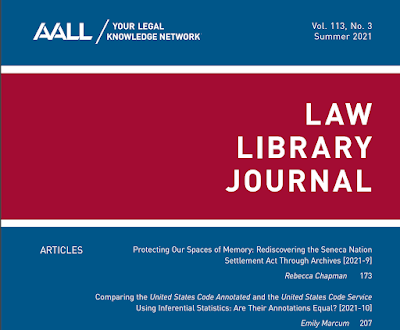
Most Recent Issue of Law Library Journal

The Summer 2021 issue of Law Library Journal, a publication of the American Association of Law Libraries, is available online.


One of the feature articles in this issue is "Comparing the United States Code Annotated and the United States Code Service Using Inferential Statistics: Are Their Annotations Equal?". 

Both are heavily annotated versions of the US Code, the massive consolidation of valid federal legislation in the United States. 

The annotated codes contain the text of U.S. federal laws, plus amendment history, related case law and references to other research materials such as encyclopedias, journal articles etc.

"There are two choices for annotated versions of the United States Code in print. The version published by West Publishing is the United States Code Annotated, or U.S.C.A., and the version published by Lexis Publishing is the United States Code Service, or U.S.C.S. Many law libraries, especially academic ones, carry copies of each, historically because they are thought to have different annotations. But which set should the researcher choose? Should the researcher use both? Should libraries continue to subscribe to both? (from the introduction)"

"(...) we can say that the case annotations given are significantly different from each other. Put differently, there is a significant amount of non-overlap between the case annotations offered by one set and those offered by the other."

"Law libraries often buy both sets of annotated codes because law librarians have historically thought the two sets different. This study confirms that. However, it is still surprising that the percentages of unique annotations were so high: 76 percent of annotations being unique to the U.S.C.A. and 70.5 percent being unique to the U.S.C.S. is much higher than I expected it to be. Given such a high percentage of diversity between the two, a researcher may be well served by examining both sets when starting research. Libraries should continue to buy both sets despite the cost burden, if possible. (from the conclusion)"

This lack of overlap between research platforms should not surprise law librarians. 

My experience is that many researchers become used to searching in one or maybe two online tools when looking for commentary or caselaw, forgetting that no platform provides anything close to comprehensive coverage. And results can be quite different depending on which database one is searching.


Labels: , , , ,

Bookmark and Share Subscribe
posted by Michel-Adrien at 7:41 pm 0 comments

Wednesday, March 31, 2021

New Website and Archive for the National Centre for Truth and Reconciliation

The National Centre for Truth and Reconciliation (NCTR), the permanent home for all statements, documents, and other materials gathered by the Truth and Reconciliation Commission (TRC) that investigated abuses against Indigenous children at Indian residential schools, has a new website.

Located at the University of Manitoba in Winnipeg, the NCTR holds millions of records.

The records include:

  • TRC reports and publications;
  • Footage from TRC public events – apologies, expressions of reconciliation and dialogues on reconciliation;
  • Thousand of hours of statements from former students, their families, staff and those affected by the residential school system;
  • Donations of material objects, art, poems and music;
  • School admissions, school histories, administration records, photographs, maps, plans and drawings from the Government of Canada;
  • Student records, duplicate photographs, school newsletters, cemetery records and religious records from church entities.
These records are stored in the AtoM (Access to Memory) database, a web-based, open source app that offers international standards and access in a multilingual environment.


Labels: , , , ,

Bookmark and Share Subscribe
posted by Michel-Adrien at 6:30 pm 0 comments

Saturday, January 09, 2021

Special Webinar on the Index to Foreign Legal Periodicals

Legal publisher HeinOnline is hosting a free webinar next week on the Index to Foreign Legal Periodicals.

It is a great tool to find secondary sources on foreign, comparative, and international law topics in multiple languages.

The HeinOnline website offers expert tips on using the Index as well as a good description of its contents.

It is produced at the Law Library of the University of California at Berkeley on behalf of the American Association of Law Libraries, which owns the copyright. 

The blog of the International Association of Law Libraries published an article this week on the topic:

"As the field of law evolves to become ever more global, legal information professionals employed by law firms and government agencies increasingly support the work of multilingual attorneys whose legal practices are transnational in scope.  Similarly, academic law librarians are often asked to assist faculty members and students in researching comparative law topics involving foreign legal systems, and to provide research instruction for advanced degree students who received their primary legal training in foreign jurisdictions.  Although many of us have some working knowledge of at least one foreign language, our familiarity with foreign legal terminology is often limited.  It can be especially challenging to assist patrons in locating jurisdiction-specific secondary law sources in languages other than English if we are completely unfamiliar with the language of the jurisdiction (...)"

"Established in 1960 as a print resource, the IFLP is now fully integrated with HeinOnline’s electronic research platform.  If your library already subscribes to HeinOnline, the IFLP is available as an affordable, cost-effective add-on to your subscription.  What follows is a brief introduction to the IFLP and an overview of its key features."

Labels: , , ,

Bookmark and Share Subscribe
posted by Michel-Adrien at 1:20 pm 0 comments

Tuesday, October 06, 2020

Reminder That No One Database Offers All the Canadian Law Journals You Need

The law library at the Université du Québec à Montréal (UQAM) in Montreal has published a useful reminder that no single online source or database provides access to all the major Canadian law journals.

This is an important issue when training new employees in legal research. 

My experience is that many researchers become used to searching in one or maybe two online tools when looking for commentary, forgetting that no platform provides anything close to comprehensive coverage. 

Discovery tools are useful but the content of some major databases with collections of Canadian law journals is not indexed in discovery.

UQAM librarians created a table of Canadian law journals indicating which ones are covered in CanLII, Lexis Advance Quicklaw, Westlaw Canada and HeinOnline along with the years of coverage for each journal.


Labels: , , ,

Bookmark and Share Subscribe
posted by Michel-Adrien at 7:17 pm 0 comments

Sunday, September 27, 2020

World Intellectual Property Organization Launches Free Database of IP Decisions from Around the World

 The World Intellectual Property Organization (WIPO) has launched  WIPO Lex-Judgments, a free database of leading decisions on intellectual property law from around the world.

As the official press release explained last week:

"WIPO-Lex Judgments contributes to a greater overall understanding of how courts are handling these issues, by making available judgments - selectively curated by the relevant authorities in participating member states - that establish precedent or offer a persuasive interpretation of IP law in their jurisdiction. At launch, WIPO Lex-Judgments contained over 400 documents from 10 countries (...)"

"By fostering accessibility of information on judicial decisions, WIPO Lex-Judgments will contribute to informing and strengthening courts’ analyses and reasoning, as well as to discerning both converging and contrasting national approaches to common IP questions."

"In addition, WIPO Lex-Judgments provides information on the judicial structures for IP disputes in participating member states. This allows users to appreciate the spectrum of structures that include generalist and specialist courts, as well as administrative entities that carry out quasi-judicial functions, and their diverse features that respond to the technical nature of IP disputes."

Labels: , , ,

Bookmark and Share Subscribe
posted by Michel-Adrien at 4:11 pm 0 comments

Wednesday, July 29, 2020

UNESCO Database on National Laws for the Protection of Cultural Heritage

The United Nations Educational, Scientific and Cultural Organization (UNESCO) has brought a number of improvements to its NATLAWS Database of National Cultural Heritage Laws. It is a tool for combating the illicit traffic in cultural property.
"In the event of a legal question about the origin of an object (which may have been stolen, pillaged, or illegally exported, imported or acquired), it is useful to have rapid access to the relevant national laws."

"The UNESCO Database of National Cultural Heritage Laws allows the following to be consulted: 
  • national laws currently in force related to the protection of the cultural heritage in general;
  • import/export certificates for cultural property (available on request);
  • official or unofficial translations of national laws and certificates;
  • contact details for the national authorities responsible for the protection of the cultural heritage;
  • addresses of the official national websites dedicated to the protection of the cultural heritage."
The database gives access to more than 3000 laws, decrees and amendments that cover areas such as monuments, archaeological sites, paintings, coins, archaeological objects, shipwrecks, underwater cities, etc.

Enhancements include the scanning of existing documentation in high-definition, improving the quality of the documents and transforming its interface making it more accessible to users.

Labels: ,

Bookmark and Share Subscribe
posted by Michel-Adrien at 7:02 pm 0 comments

Wednesday, July 22, 2020

World Health Organization Database of COVID-19 Legislation Around the World

The World Health Organization (WHO) has launched the COVID-19 Law Lab in association with other major international organizations:
"The COVID-19 Law Lab is a database of laws that countries have implemented in response to the pandemic. It includes state of emergency declarations, quarantine measures, disease surveillance, legal measures relating to mask-wearing, social distancing, and access to medication and vaccines. The database will continue to grow as more countries and themes are added."
"It will also feature research on different legal frameworks for COVID-19. These analyses will focus on the human rights impacts of public health laws and help countries identify best practices to guide their immediate responses to COVID-19 and socioeconomic recovery efforts once the pandemic is under control."
There are legal documents from over 190 countries.

In addition to the WHO, the project involves the United Nations Development Programme, yhe UN Programme on HIV/AIDS and the O’Neill Institute for National and Global Health Law at Georgetown University.

Labels: , , , ,

Bookmark and Share Subscribe
posted by Michel-Adrien at 7:28 pm 0 comments

Tuesday, July 07, 2020

July/August 2020 Issue of AALL Spectrum

Bookmark and Share Subscribe
posted by Michel-Adrien at 5:08 pm 0 comments

Monday, June 22, 2020

US Police Reform Bill Tracking Database

The American National Conference of State Legislatures has launched a Legislative Responses for Policing-State Bill Tracking Database to help people follow the dozens of bills or executive orders addressing law enforcement issues in various US states:
"The National Conference of State Legislatures provides you with up-to-date, real-time information on law enforcement legislation that has been introduced in the 50 states and the District of Columbia. The database contains policing bills and executive orders introduced as of May 25, 2020, that are in response to recent events."

"You can search legislation for by state, topic, keyword, year, status or primary sponsor. Policing topics include oversight and data, training, standards and certification, use of force, technology, policing alternatives and collaboration, executive orders and other timely issues."

Labels: , , ,

Bookmark and Share Subscribe
posted by Michel-Adrien at 6:59 pm 0 comments

Wednesday, April 10, 2019

Free Gladue Rights Database

The University of Saskatchewan has developed an open access Gladue Rights Research Database to help with pre-sentencing reports for indigenous offenders:
"This database is designed to provide much, but not all, the information required to write or review a Gladue report. It provides solid comprehensive information explaining the unique circumstances that have impacted and shaped Indigenous people’s lives in Saskatchewan – the essential historical backgrounds and contexts to the situations Aboriginal people face today. The additional recent and intimate personal information needed to complete particular Gladue reports must be acquired separately." (...)

"Gladue rights derive from Section 718.2(c) of the Criminal Code. The Supreme Court handed down its decision in R. v. Gladue in 1999. Gladue rights are enjoyed by First Nations, Inuit, and Metis people. They emerge from the unique experiences and circumstances that Aboriginal people have suffered under settler colonialism. That is to say, Gladue rights are derived from Aboriginal people’s unique history as the original occupants of this land and their distinct experiences as the victims of settler colonialism: “…the circumstances of aboriginal people are unique. In sentencing an aboriginal offender, the judge must consider: (a) the unique systemic or background factors which may have played a part in bringing the particular aboriginal offender before the courts; and (b) the types of sentencing procedures and sanctions which may be appropriate in the circumstances for the offender because of his or her particular aboriginal heritage or connection…. Judges may take judicial notice of the broad systemic and background factors affecting aboriginal people, and of the priority given in aboriginal cultures to a restorative approach to sentencing.” (https://scc-csc.lexum.com/scc-csc/scc-csc/en/item/1695/index.do)"

Labels: , , ,

Bookmark and Share Subscribe
posted by Michel-Adrien at 7:32 pm 0 comments

Thursday, February 07, 2019

Canadian Association of Law Libraries Project Profiles

The Canadian Association of Law Libraries (CALL) has started a series of project profiles on its website.

The profiles are intended to showcase interesting or innovative work conducted by CALL members.

This most recent profile is about Project managing a database of regulatory requirements for an enterprise client and it highlights the work of Victoria Baranow, Project Manager—Regulatory Compliance at Norton Rose Fulbright Canada:
"We are creating a database of regulatory requirements found in legislation and in the documentation of other regulatory-type bodies for about 40 jurisdictions. These are requirements to which our client must adhere in order to be considered in ‘good standing’. It is an absolutely massive project. Our database currently has nearly 30,000 entries, of which more than 17,200 entries impose requirements upon our client."

Labels: , , ,

Bookmark and Share Subscribe
posted by Michel-Adrien at 6:16 pm 0 comments

Sunday, December 02, 2018

US Government Information Portal FDsys Officially Retires December 14

The U.S. government has been testing govinfo.gov, a government information portal that is intended to replace the Federal Digital System (FDsys) that contains official versions of Congressional, Presidential, judicial and federal agency materials.

The government has now announced that FDsys will retire on December 14, 2018:
"govinfo, launched in beta in February 2016, offers many enhancements to the way the public accesses more than one million documents from all three branches of the United States Federal Government. Highlights include a modern, mobile-friendly design; links to related documents of interest; curated feature articles with links to famous documents such as the 9/11 Commission Report, the Warren Commission Report, and the Starr Report; quick and easy social sharing; the ability to browse collections A–Z and by category; sortable search filters; RSS notifications feeds; a search engine that makes search results more relevant than ever; shorter URLs; and more. When the FDsys website is retired, existing links will redirect to govinfo. govinfo had more than 424 million retrievals in fiscal year 2018."

Labels: , , , ,

Bookmark and Share Subscribe
posted by Michel-Adrien at 3:16 pm 0 comments

Wednesday, November 28, 2018

Databases on Quebec National Assembly Website Now Go Way Back

The website of the Québec National Assembly has expanded the historical range of many of its databases:

Labels: , , ,

Bookmark and Share Subscribe
posted by Michel-Adrien at 6:28 pm 0 comments

Wednesday, October 31, 2018

Free WIPO Global Database on Intellectual Property Law

I learned today that the World Intellectual Property Organization, a specialized Agency of the United Nations, maintains WIPO Lex, a free database with information on international IP treaties as well as laws and regulations of some 200 countries.

According to an explanation on the website:
"WIPO Lex aims to achieve the objective set forth in Article 4(vi) of the WIPO Convention, that is, WIPO 'shall assemble and disseminate information concerning the protection of intellectual property, carry out and promote studies in this field, and publish the results of such studies.' WIPO Lex covers all WIPO Member States (...)"

"WIPO Lex also covers IP legal information of the Members of the World Trade Organization (WTO) in accordance with the Agreement between WIPO and WTO of December 22, 1995, which provides for the WTO Secretariat to transmit to the International Bureau of WIPO, a copy of the laws and regulations received by the WTO Secretariat from WTO Members under Article 63.2 of the Agreement on Trade-Related Aspects of Intellectual Property Rights."

Labels: , , ,

Bookmark and Share Subscribe
posted by Michel-Adrien at 6:39 pm 0 comments

Thursday, April 19, 2018

Getting to Know the Index to Foreign Legal Periodicals Part Two

This is a follow-up to the February 26, 2018 post entitled Getting to Know the Index to Foreign Legal Periodicals.

The Index has been around since 1960 and is now available on the HeinOnline platform.

In this 2nd post, DipLawMatic Dialogues, the blog published by the Foreign, Comparative, and International Law Special Interest Group of the American Association of Law Libraries, looks at the breadth and scope of the database:
"As its name implies, the IFLP focuses primarily on law journals published outside the U.S. Casual users of the Index may be surprised at just how broad its coverage is. The IFLP includes over 365,000 records of articles and book reviews published in more than 500 top law journals from jurisdictions throughout the world. More than 60,000 of these articles are available in full text on HeinOnline. Articles from nearly four dozen international, regional, jurisdiction-specific, and subject-specific legal yearbooks also are included. In addition, the IFLP analyzes the contents of approximately 50 individually published collections of essays, Festschriften, Mélanges, and congress reports each year. Roughly half of the articles indexed are published in languages other than English. In total, more than two dozen languages are represented, making the IFLP the only truly multilingual index to legal scholarship worldwide."

Labels: , , , ,

Bookmark and Share Subscribe
posted by Michel-Adrien at 6:40 pm 0 comments

Wednesday, April 11, 2018

US Government Publishing Office Digitizes Entire Collection of Federal Register

The Government Publishing Office (GPO), the official publisher of the U.S. government, has completed the digitization of all issues of the Federal Register going back to the initial issue in 1936.

The Federal Register is the official daily publication for rules, proposed rules, and notices of Federal agencies and organizations, as well as executive orders and other presidential documents. It is analogous to the Canada Gazette.

The material is available on the Govinfo information portal which contains official versions of US Congressional, Presidential, judicial and federal agency materials.

Labels: , , ,

Bookmark and Share Subscribe
posted by Michel-Adrien at 5:52 pm 0 comments

Monday, February 26, 2018

Getting to Know the Index to Foreign Legal Periodicals

DipLawMatic Dialogues, the blog published by the Foreign, Comparative, and International Law Special Interest Group of the American Association of Law Libraries, has a post today called Getting to Know the Index to Foreign Legal Periodicals.

This is a happy coincidence since I was playing round in that very same IFLP index earlier today.

It has been around since 1960 and is now available on the HeinOnline platform.

Today's post is intended to be the first in a series to make this valuable resource more well-known by explaining its breadth and scope, providing examples on how to use the index and highlighting unique features.

One interesting idea:
"We also encourage you to submit examples of how you have used IFLP for research, ideas on how others can promote usage of the Index, and ideas or examples of how to teach patrons to search the Index.  To this end, we will be adding a form to the IFLP website where you can submit your suggestions and comments."

Labels: , , , ,

Bookmark and Share Subscribe
posted by Michel-Adrien at 6:14 pm 0 comments