Tuesday, December 10, 2024

Outlaw Oceans Project Databases

I came across this recently: the Outlaw Oceans Project, a Washington-based journalism non-profit that publishes stories about human rights, labour and environmental issues on the high seas:

"More than 50 million people work offshore. Roughly 80 percent of the goods we consume reach us by way of the sea. Half the air we breathe comes from the oceans. And yet, this realm is home to a variety of urgent concerns that go largely overlooked by most news outlets because it is too costly, too dangerous and too time consuming to report on them. These concerns include the murder of stowaways, arms trafficking, illegal fishing, pollution, dumping, drilling and human slavery on fishing ships. The organization was founded and is directed by Ian Urbina, who produced an award-winning series in 2015 in The New York Times and a subsequent best-selling book in 2019."

"The Outlaw Ocean Project’s journalism is distinct not just in its focus, but also in how the reporting is conducted and distributed. Most of the stories are reported at least partially at sea. In the United States, the non-profit publishes its stories in various news outlets, including the New Yorker, NBC News, The Atlantic and The Washington Post. The reporting is also translated into a half dozen languages and further disseminated abroad in partnership with dozens of foreign newspapers, magazines, radio and television venues."

The Project offers a toolkit of 3 databases:

Labels: , , , , , ,

Bookmark and Share Subscribe
posted by Michel-Adrien at 7:50 pm 0 comments

Tuesday, June 18, 2024

Recent Government of Canada Publications from the Weekly Acquisitions List

The Government of Canada's Weekly Acquisitions List can be a great way to discover new research reports published by various public bodies and agencies of the federal government. 

It is a record of all publications catalogued in the previous week.

Some of the documents in the most recent list include:

Labels: , , , , , ,

Bookmark and Share Subscribe
posted by Michel-Adrien at 9:04 pm 0 comments

Monday, March 18, 2024

Law Commission of Ontario Report on A New Environmental Bill of Rights for Ontario

The Law Commission of Ontario (LCO) has published A New Environmental Bill of Rights for Ontario: Final Report.


The report examines Ontario's existing Environmental Bill of Rights (EBR) and makes a series of major recommendations to enhance environmental accountability in the province.

The EBR was proclaimed in February 1994 and it introduced a number of mechanisms to improve public participation, transparency, and government accountability for environmental decision-making. 

The LCO concludes that the EBR has not always been meeting its stated objectives and needs updating.

The report's 58 recommendations for change are listed in Appendix A of the report.


Labels: , ,

Bookmark and Share Subscribe
posted by Michel-Adrien at 6:42 pm 0 comments

Monday, February 26, 2024

Law Library of Congress Comparative Table on Carbon Neutrality Legislation Around the World

The Law Library of Congress in Washington, D.C. recently published a table on Carbon Neutrality Legislation Around the World:

"This table shows the 57 jurisdictions around the world that the Law Library of Congress has identified as having a net zero emissions or climate neutrality goal set forth in existing or pending legislation. The table highlights existing legislation with established targets and the most recent legislative proposals that are not yet enacted. Existing legislation includes that of the European Union (EU) and its 27 member states, where a June 2021 regulation sets 2050 as the target date for climate neutrality. Fifteen EU member states have passed their own legislation in addition to the directly applicable regulation, including three that have set an earlier target date. To date, 25 jurisdictions outside the EU have passed legislation containing a carbon neutrality or net zero emissions goal, with four jurisdictions (Gibraltar, Iceland, Maldives and Scotland) setting a target date earlier than 2050, while two jurisdictions (Kazakhstan and Nigeria) target the achievement of carbon neutrality later that 2050. At least two other countries (Argentina and Israel) have proposed legislation that includes the goal, and one nation (Chile) has proposed legislation specifying electricity transmission as an enabling sector for carbon neutrality. Two jurisdictions (Russia and the United Kingdom) have enacted laws with carbon neutrality or net zero goals at the subnational level, while Brazil has proposed legislation with the goal of net carbon neutrality in the Brazilian Amazon."

The Law Library of Congress is the world’s largest law library, with a collection of over 2 and a half million volumes from all ages of history and virtually every jurisdiction in the world.

Over the years, it has published dozens of comparative law reports which are a treasure trove for legal research on a huge variety of issues.

Labels: ,

Bookmark and Share Subscribe
posted by Michel-Adrien at 3:58 pm 0 comments

Monday, January 09, 2023

New and Updated Research Guides from GlobaLex

GlobaLex, a very good electronic collection created by the Hauser Global Law School Program at the New York University School of Law, has  published or updated a number of research guides recently:

  • The Execution of the International Public Contract during the COVID-19 Pandemic: A Comparative Perspective: "Many questions arose about the impact of the COVID-19 Pandemic on contracts and legal agreements. Additionally, the legislator is responsible, on the one hand, to insert explicit provisions that can deal with those cases in the national legislation, and on the other hand, there is also a responsibility on the contractual parties to include in contracts some articles which could deal with disaster and Force Majeure cases, and other articles to define the rights and obligations of each party in these cases. In all cases, the political considerations and the circumstances surrounding each contract must be considered separately. Therefore, it becomes necessary to clarify the effect of the pandemic on the execution of the international administrative contract. Is it a Force Majeure? What are the rights of each party during the period of the pandemic?"
  • UPDATE: Researching the United Nations: Finding the Organization's Internal Resource Trails: "The United Nations is such a massive organization that its wide array of processes and products require enough reference sources to warrant a map and compass for navigation. As a map, here are suggested search techniques for several standard types of queries and, as a compass, here are the U.N.'s many diverse search tools organized into resource types."
  • UPDATE: An Introduction to International Fisheries Law Research: "International fisheries law, a subfield of the law of the sea, is an emerging area of public international law that seeks to regulate fisheries management in areas within and beyond national jurisdictions. This body of law touches upon some other areas of international law, for example, international environmental law, international marine environmental law, natural resources law, sustainable development law, international trade law, etc. International fisheries law is also interdisciplinary as it often draws on other disciplines, such as, fisheries and marine science, oceanography, marine resource management, fisheries economics, fisheries statistics etc. Although international fisheries law is primarily based on international and regional treaties and customs, other elements, such as, decisions of international courts and tribunals on fisheries matters, practices of States and regional fisheries management organizations (RFMOs), and scholarly writings and publications by leading experts have also contributed to shaping up this evolving area of international law."
  • UPDATE: Researching the Inter-American System of Human Rights: "The purpose of this research guide is twofold. The first purpose is to serve as a document that will give the reader a basic understanding of the Inter-American System of Human Rights by presenting a brief history of the Inter-American System of Human Rights, the institutional organs through which the System functions and the enabling instruments of the System. The second purpose is to serve as a point of departure for in-depth research. My comments will be limited to the mission, the internal structure, the administrative organization, and the research materials available at the Inter-American Commission on Human Rights website."

Labels: , , , , , ,

Bookmark and Share Subscribe
posted by Michel-Adrien at 6:43 pm 0 comments

Thursday, September 22, 2022

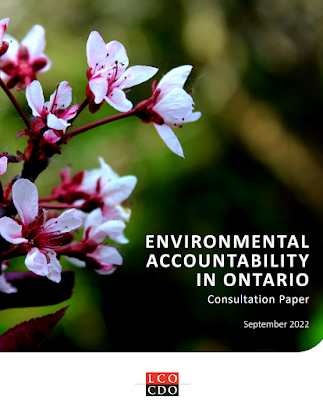
Law Commission of Ontario Consultation Paper on Environmental Accountability

The Law Commission of Ontario (LCO) has published a consultation paper on environmental accountability.

"The EBR [Environmental Bill of Rights 1993] was enacted over 25 years ago. Since then, the environmental, policy, and legal landscape in Ontario has changed considerably. New issues have emerged, including important developments in the relationship between the Crown and Indigenous Peoples; the growing recognition of environmental justice; and the adoption of the right to a healthy environment by most member states of the United Nations. These new developments underscore the need to re-examine the substantive and procedural requirements of the EBR to ensure it reflects and is responsive to current realities (...) an underlying premise of the EBR is that the public and the government share responsibility for protecting the environment. The EBR sought to achieve its objectives by enhancing public participation rights in government decision making process on environmental matters. It was anticipated that this would improve accountability and transparency leading to better environmental outcomes (...)"

"The Consultation Paper asks two sets of questions. First, the paper asks about potential reforms to the EBR. Second, the paper asks potentially more far-reaching and challenging questions about emerging legal concepts of “environmental justice,” the “right to a healthy environment,” and how to account for Indigenous issues and legal orders in Ontario’s environmental accountability framework (...)"

"Finally, readers will know that environmental accountability is a complex, controversial, and politicized subject. The LCO is committed to bringing its rigorous, evidence-based and non-partisan approach to this project. The LCO’s goal is to move beyond the rhetoric and ask hard but fair questions about Ontario’s experience; the desirability, feasibility, and enforceability of reasonable law reform options; and how environmental accountability measures might be balanced against competing rights and economic interests."

The Commission will consult widely with stakeholders, including lawyers and legal organizations, environmental NGOs, industry representatives, academics, Indigenous communities, government and justice system leaders, and individual Ontarians interested in environmental issues. The consultation period ends in late November 2022.

Labels: , , ,

Bookmark and Share Subscribe
posted by Michel-Adrien at 7:00 pm 0 comments

Monday, September 20, 2021

New and Updated Globalex Research Guides on Foreign and International Law Topics

GlobaLex, a very good electronic collection created by the Hauser Global Law School Program at the New York University School of Law, has published and updated a number of research guides recently:

  • Judicial Power and High Courts in Latin America: "The Latin American legal systems are within the tradition of civil law with elements of Roman law. They have been articulated with liberal rationalist reforms of the eighteenth and nineteenth centuries in Europe, mediated by the Spanish and Portuguese colonial administration, as well as some reproduction of the North American constitutionalist model. The way these systems were adopted showed some hybridity between public law (based on the separation of American and French powers) and civil law (adapted from the Napoleonic Code). Historically, the concentration of power and procedures typical of colonial characteristics resulted in a greater presence of the centralist aspects of the French system than the control and balance mechanisms of the North American system. From this system, the presidential form of government was taken, as well as the federal model, which was widely adopted in the nineteenth century, and which is still maintained today by the most extensive and populated countries (such as Mexico, Venezuela, Brazil, and Argentina).During the 1970s, ’80s, and ’90s, the judiciary in Latin America began to undergo a profound rethinking to accommodate demands for the effective application of the law and the need to carry out judicial reforms aimed at ensuring greater efficiency and autonomy with respect to executive powers. For this reason, after democratic transitions, the Latin American judicial powers were considered more relevant to understand the political functioning of the region."
  • Discovering the United States-Mexico-Canada Trade Agreement (USMCA): "The objective of this article is to serve as a one stop research guide to the United States-Mexico-Canada Agreement (USMCA) and to point out some of the changes instituted by the passage of USMCA and the annulment of NAFTA. The major documents and institutions related to the USMCA Agreement are identified, and a citation to the item is given. The websites cited were chosen for the authority and reputation of the sponsor of the website and the completeness of information provided. The updating policy and the ease of navigation of the websites were also considered for inclusion into this article. Also, free websites were favored over websites that required payment. Websites with little information on the website itself and consisting mainly of links to other websites for the actual desired information were avoided. Most of the citations found in this article are annotated as to content and research value of the website. "
  • UPDATE: International Commercial Contracts: "Transactions conducted under international commercial contracts, especially those related to the sale of goods, are considered to form the backbone of international trade. The goal of this research guide is to provide an overview of the major primary sources of law for international commercial contracts, in particular those related to sales, and the related research resources. The focus is global, and the guide does not cover regionally focused instruments or economic integration organizations, such as the European Union. "
  • UPDATE: Researching International Marine Environmental Law: "Today, although nations with expansive marine coasts and harbors can be considered fortunate in that they have easy access to global trade, they have also become the recipients of marine pollution caused by oceanic traffic. Naturally, there is a call for an increase in the regulation of growing environmental harm caused by international vessel traffic. For decades, such calls are handled by the International Maritime Organization (IMO, or the Organization). It is a special agency of the United Nations responsible for regulating maritime affairs and oceanic shipping. However, before proceeding to learn more about the responsibilities and functioning of the Organization, due recognition must be given to several non-governmental organizations (NGOs) and inter-governmental organization (IGOs), which operate at regional or local levels and complement or supplement the efforts of the IMO. Many of these organizations, as well as the IMO, have developed impressive websites. An exhaustive treatment of the non-IMO resources would fill up volumes and take considerable time and money, so, for the time being, this article will briefly discuss prominent websites and emphasize sources that reflect and assist the efforts of the IMO to develop international instruments to regulate the marine environment. For the most part, the information at these sites is made available at no charge. However, sources that charge for information access, as well as the sources that provide restricted access, are included when appropriate."

Labels: , , , , ,

Bookmark and Share Subscribe
posted by Michel-Adrien at 9:15 pm 0 comments

Tuesday, June 29, 2021

Recent Legislative Summaries from Library of Parliament

The Library of Parliament has recently published a number of new and revised summaries of legislation.

These include:

All legislative summaries can be found on the Library of Parliament website.

It is possible to follow the progress of  bills through the Canadian Parliament on the LEGISinfo website. There you can find the different versions of a bill, debates, committee hearings, and coming into force information.

Labels: , , , , , , ,

Bookmark and Share Subscribe
posted by Michel-Adrien at 8:56 pm 0 comments

Monday, February 08, 2021

Recent Legislative Summaries from Library of Parliament

The Library of Parliament has recently published a number of legislative summaries if bills currently being debated.


Labels: , , , , , , , , , ,

Bookmark and Share Subscribe
posted by Michel-Adrien at 5:14 pm 0 comments

Thursday, April 09, 2020

Most Recent Issue of LawNow: Rural Law

The most recent issue of LawNow is available online. The magazine is published by the Centre for Public Legal Education Alberta.

The issue features a series of articles that look back at  major legal developments over the past 20 years.

There is also a special report on the state of the law in rural communities.

Labels: , , , , , , ,

Bookmark and Share Subscribe
posted by Michel-Adrien at 6:48 pm 0 comments

Wednesday, January 16, 2019

New International Law Research Guide on Right to Water

GlobaLex, a very good electronic collection created by the Hauser Global Law School Program at the New York University School of Law, has published a new research guide on the Human Right to Water:
" 'The human right to water' is the right of natural persons either individual or collective against international entities—including states, international organizations, and multi-national corporations—to the civil and political, economic, social, or cultural aspects of water in terms of quality, quantity, or access (...)"

"In order for governments, non-governmental organizations, and individuals to effectively advocate and claim the human right to water, they need access to research that provides all the applicable legally binding instruments and persuasive sources of law, including decisions from international and national courts and opinions of highly qualified publicists. The human right to water research presented herein will contribute to advocacy and litigation efforts at local, city, county, state, national, and international levels. Researching the human right to water requires use of a wide variety of legal instruments and documents produced by inter-governmental and non-governmental organizations and states. This research is made more difficult by the complex interplay of interests behind the recognition of the human right to water, the difficulty of defining water and the human right to water, the diversity of stakeholders involved (including indigenous people and minority groups), as well as the complicated and interdisciplinary nature of research (including data, statistics, strategies, implementation plans, and training materials). It is further convoluted by the many different types of relevant legal sources, including international treaties, international custom, general legal principles, jurisprudence, soft law, and domestic laws."

Labels: , , , ,

Bookmark and Share Subscribe
posted by Michel-Adrien at 6:08 pm 0 comments

Tuesday, June 12, 2018

Updated International Law Research Guides From GlobaLex

GlobaLex, the electronic collection created by the Hauser Global Law School Program at the New York University School of Law, recently updated some of its research guides:
  • Sustainable Development Law (SDL) Research Guide: "Historically, sustainable development law has often focused on environmental issues in developed countries. Indeed, sustainable development was recognized long before the 1972 Stockholm UN Conference on the Human Environment (culminating in the Stockholm Declaration). Scholars, citizens, and government officials have debated the tension between the Earth’s natural resources and the needs of both current and future generations. More recently, the field of Sustainable Development Law (SDL) has shifted to an integration of international economic, social, and environmental law. Human rights advocates hope that this more integrated approach will allow SDL to respond more nimbly to chronic, complex issues like poverty (...) This guide will provide an extended introduction to the topic in an effort to aid legal researchers, but it is not intended to be comprehensive. Researchers will likely find the interdisciplinary nature of this field to be challenging. SDL can be found in traditional primary law, as well as soft law. As this field evolves, policy and scholarly work will continue to move the discussion and legal developments forward."
  • Research Guide on Global Health Law: "Included are a wide array of resources, ranging from primary 'hard' international law instruments, to databases that contain domestic health-related legislation. Also included are suggestions for researching the relationships between global health law and international human rights, trade, and intellectual property. In terms of format, the guide emphasizes electronic sources, but some print monographs are also mentioned. All of the listed resources are available in English, although several are multilingual. The aggregate purpose of the guide is to provide a comprehensive roadmap for researching the highly complex and dynamic field of global health law."
  • Contemporary Land Grabbing, Research, and Bibliography: "Contemporary land grabbing often involves large-scale land acquisitions by foreign and/or nonindigenous investors. These acquisitions, in turn, cause issues such as land alienation from local communities, human rights violations, and loss of livelihoods and culture (...) Research is made more difficult by the complex reasons and motivations behind contemporary land grabbing, the number of stakeholders involved, the interdisciplinary nature of research, the many different types of legal sources to search (for example, international treaties, custom, jurisprudence, soft law, and domestic statutes and customary law), lack of empirical evidence, and scattered resources in many different places. The research is a mixture of international and domestic legal research and legal and non-legal research. In this research guide, I first investigate the definitions of contemporary land grabbing and land alienation. Next, I delineate various mechanisms and international principles that can be useful for protecting the rights of indigenous and local people relating to land from the attack of state and nonstate actors. Finally, I selectively review several books and articles that provide excellent starting points for contemporary land grabbing research."

Labels: , , , ,

Bookmark and Share Subscribe
posted by Michel-Adrien at 6:42 pm 0 comments

Wednesday, March 28, 2018

Recent Research Publications from Canada's Library of Parliament

The Library of Parliament has published a number of research publications recently:
  • The New Veterans Charter: Developments Since Its Adoption in 2006 : "On 1 April 2006, the Canadian Forces Members and Veterans Re-establishment and Compensation Act1 came into force. Commonly known as the New Veterans Charter (NVC), it became the legislative framework for the programs, services and benefits provided to Canadian veterans through Veterans Affairs Canada (VAC) (...) Since the NVC was adopted, various stakeholders have reviewed the regime it established. They noted its positive aspects, but also identified significant shortcomings. Many recommendations to improve the new programs have been put forward by, among others, the Veterans Ombudsman, the parliamentary committees on veterans' affairs, the New Veterans Charter Advisory Group, and various veterans' rights groups. Changes have been made to address some of these shortcomings. For example, the budget implementation bills of June 2014, 2015, 2016 and 2017 brought in changes and added new provisions to the NVC.This document summarizes the purpose and content of the NVC, the changes made to date, and some ongoing issues."
  • Cybersecurity: Technical and Policy Challenges : "Starting with a quick overview of some of the types of cyberthreats confronting Canada and its allies, this paper examines how Canada defines cybersecurity and considers the many human, technical, economic and political factors that make achieving cybersecurity so difficult. Finally, it touches on some of the international initiatives that have been undertaken to enhance cybersecurity."
  • Carbon Pricing Policy in Canada : "Policies that put a price on greenhouse gas (GHG) emissions are in place in a number of jurisdictions. Commonly referred to as “carbon pricing systems,” they are meant to help reduce the GHG emissions that are contributing to climate change. In Canada, carbon pricing policy is in development. On 15 January 2018, the federal government published for public comment a document on draft legislation aimed at codifying its proposed national carbon pricing system. The Greenhouse Gas Pollution Pricing Act is expected to be introduced in the House of Commons during the 1st Session of the 42nd Parliament. The proposed legislation would require provinces and territories to implement carbon pricing systems by 1 January 2019, or adopt a federally administered carbon pricing system that the federal government calls the 'backstop.' Jurisdictions where no carbon pricing system is adopted, or where the pricing system fails to meet federal standards, will have the backstop imposed on them, in whole or in part, on the same date. Several Canadian provinces have already implemented some form of carbon pricing, and other provinces and territories have either announced pricing systems or are studying the question. The federal government has asked provinces and territories to detail their carbon pricing approach by 1 September 2018. After a discussion of what carbon pricing is and how it works, this document presents the federal, provincial and territorial pricing systems. "

Labels: , , , , ,

Bookmark and Share Subscribe
posted by Michel-Adrien at 4:13 pm 0 comments

Wednesday, October 28, 2015

OECD Environment at a Glance Report

This is a follow-up to the post of October 18, 2015 entitled New Climate Initiatives Database that described a database commissioned by the Nordic Council of Ministers to track initiatives from around the world to mitigate greenhouse gas emissions.

The Organisation for Economic Co-operation and Development has released a report called Environment at a Glance that describes the progress on major environmental issues in advanced industrial economies:
"Environment at a Glance 2015 highlights the many OECD countries that have succeeded in reducing their greenhouse gas emissions, and those that have increased their share of renewables in energy supply, improved their waste management, or innovated to more efficiently manage their water resources. The data are there to prove it: whether we are talking about natural resource consumption, waste generation or air emissions, decoupling is possible. These positive developments are attributable both to the rise of the services sector and with it, the displacement of resource- and pollution-intensive production abroad, as well as to policy action and technical progress. The economic crisis also contributed to relieve some pressures on the environment."

"Environment at a Glance also reveals where progress has slowed or is insufficient. There is substantial scope for strengthening air and climate policies, changing patterns of energy consumption, improving waste and materials management, preserving biodiversity and natural assets, and implementing more integrated policies – all critical components of green growth and sustainable development. Many positive developments still take place at the margin and policies often lack coherence, thus undermining efforts to reduce negative environmental impacts."

"Climate change has been on our agenda for many years. It is now an urgent challenge and a potentially irreversible threat to future economic development and well-being. The carbon intensity of the energy used in human activities has hardly changed since 1990 and fossil fuels continue to dominate energy supply. CO2 emissions from fuel combustion, calculated by the International Energy Agency, have increased by 36% globally since 2000, in line with global economic growth. With current policies, global energy-related CO2 emissions are estimated to reach three times the level they need to be at in 2050 to limit the long-term increase in global temperatures to 2°C. More recent estimates indicate a flattening of the CO2 emission growth rate in 2014, not tied to economic activity. Whether this indicates a new trend remains to be seen in the years to come."

"Countries continue to support fossil fuel production and consumption in many ways. Not all fossil fuels are treated equal. Variations in energy tax rates, uneven price signals, low levels of taxation on fuels with high environmental impacts, and exemptions for fuel used in some sectors impede the transition to a low-carbon economy. Coal is usually the least heavily taxed of all fossil fuels but the most carbon-intensive fuel available for electricity generation. This suggests important opportunities for reforming countries’ tax systems, aligning policies and achieving environmental goals more cost effectively."
[Source: Library Journal Infodocket]

Labels:

Bookmark and Share Subscribe
posted by Michel-Adrien at 6:48 pm 0 comments

Sunday, October 18, 2015

New Climate Initiatives Database

The Nordic Council of Ministers has commissioned a database called the Climate Initiatives Platform to track initiatives from around the world to mitigate greenhouse gas emissions.

From the About section:
"The Website is currently a work in progress or 'open beta' release and presents interim results of this ongoing project. The information included on initiatives in this first phase is a 'snapshot' drawn from information provided on publicly available websites and documents. Information was gathered during Autumn 2014 and the authors have attempted to faithfully represent basic information about the initiatives in order to steer the user to the initiative and its work."
Initiatives cover a range of areas including  energy production and supply and renewable energy policy and they have been launched by national and subnational governments, NGOs and corporations.

The database is being updated to present the most recent data and developments during the upcoming COP21 climate conference in Paris. The database will be transferred after the conference to the United Nations Environment Programme.

[Source: Infodocket]

Labels: , ,

Bookmark and Share Subscribe
posted by Michel-Adrien at 4:40 pm 0 comments

Thursday, October 16, 2014

Updated Library of Parliament Publication on Bulk Water Removals

The Library of Parliament recently updated its background paper on Bulk Water Removals: Canadian Legislation :
"For decades, Canadians have been raising concerns about the possibility of fresh water being removed from Canadian lakes and waterways in bulk, including for export to the United States and beyond. The federal government has consistently opposed bulk removal of Canadian water, but it does not have exclusive jurisdiction over water issues in Canada; substantial jurisdiction resides with the provinces." 
"After outlining the legislative powers relevant to bulk water removals that the Constitution has assigned to Parliament and to the provincial legislatures, this paper briefly discusses legislative developments since a failed Canada-wide accord in 2000, which would have prohibited bulk water removals from Canada’s major watersheds. This paper then outlines, in a table, current federal, provincial and territorial legislation relating to bulk water removals."

Labels: , , ,

Bookmark and Share Subscribe
posted by Michel-Adrien at 4:20 pm 0 comments

Tuesday, June 24, 2014

English Law Commission Report on Conservation Covenants

The English Law Commission has released its final report on Conservation Covenants:
In this report, we make recommendations for the introduction of a new statutory scheme of conservation covenants in England and Wales.

Our recommendations to introduce such a scheme would create a new legal tool, enabling landowners to protect land in order to conserve and restore our natural and built environment. Conservation covenants would allow landowners voluntarily to create binding obligations on their own land to meet a conservation objective, such as preserving woodland, cultivating a particular species of plant or protecting a habitat for an animal, or farming land in a certain way. Our proposed statutory scheme would give individual landowners the opportunity, using private agreements, to contribute to conservation efforts being made across England and Wales (...)  
In recent years there has been an appreciation – both in this and other countries – of the contribution that can be made by landowners to a nation’s conservation efforts. As a result many countries, including Australia, New Zealand, the USA and Scotland, have given legal recognition to voluntary conservation agreements in the form of conservation covenants.

Two main benefits flow from the introduction of conservation covenants: missed conservation opportunities can be captured, and the need to use workarounds to create private conservation obligation in relation to land is reduced, if not eliminated. Conservation covenants will assist the efforts of private individuals and communities who seek to conserve, protect, restore or enhance our historical and environmental assets. They will also be a cheaper way of realising conservation agreements than the existing methods. In particular, conservation bodies and public bodies will no longer have to purchase land in order to protect it or undertake conservation activities in relation to it.

Labels: , , , ,

Bookmark and Share Subscribe
posted by Michel-Adrien at 1:11 pm 0 comments

Wednesday, June 11, 2014

Law Library of Congress Report on Restrictions on Genetically Modified Organisms

The Law Library of Congress in Washington, D.C. has published a new comparative report on Restrictions on Genetically Modified Organisms.

The report analyzes legislation on genetically modified organisms (GMOs) and genetically modified (GM) plants and foods in Argentina, Belgium, Brazil, Canada, China, Egypt, England and Wales, France, Germany, Israel, Italy, Japan, Lebanon, Mexico, the Netherlands, New Zealand, Norway, the Russian Federation, South Africa, South Korea, Sweden, and the United States.

There is also a bibliography.

Earlier comparative law reports from the Law Library of Congress have covered topics such as:
The Law Library of Congress is the world’s largest law library, with a collection of over 2.65 million volumes from all ages of history and virtually every jurisdiction in the world.

Labels: , , , , , , ,

Bookmark and Share Subscribe
posted by Michel-Adrien at 3:29 pm 0 comments

Tuesday, October 22, 2013

Law Library of Congress Comparison of Regulations Concerning the Private Possession of Big Cats

The Law Library of Congress has produced a report that compares the Regulations Concerning the Private Possession of Big Cats:
"This analysis compares and contrasts the different legal approaches taken by twenty-one countries and the European Union in regulating the private possession of big cats. All the countries surveyed are members of the Convention on International Trade in Endangered Wild Fauna and Flora (CITES). This analysis describes the legal provisions regarding keeping big cats in captivity, the requirements for licenses, and permission for breeding of big cats."
Canada is one of the countries included in the report.

The Law Library of Congress is the world’s largest law library, with a collection of over 2.65 million volumes from all ages of history and virtually every jurisdiction in the world.

Labels: , ,

Bookmark and Share Subscribe
posted by Michel-Adrien at 4:48 pm 0 comments

Wednesday, April 10, 2013

New United Nations Research Guides

The United Nation's Headquarter Library in New York has launched several new research guides to honour the 60th anniversary of the appointment of Dag Hammarskjöld as Secretary-General.

He took the oath of office on April 7 1953 and served as Secretary-General until the 18th of September 1961, when he died in a plane crash while on a peace mission in the Congo.

The guides include:


Labels: , , , , , , , , , , , , ,

Bookmark and Share Subscribe
posted by Michel-Adrien at 6:28 pm 0 comments