Monday, December 09, 2024

Most Recent Issue of the Canadian Law Library Review

The most recent issue of the Canadian Law Library Review (CLLR) is available online.


The CLLR is the official journal of the Canadian Association of Law Libraries (CALL). It is an open access publication.

Check out the feature article "Inescapable Skills: Testing Legal Research Skills in an Escape Room" by  David H. Michels and Hannah Rosborough of the  Sir James Dunn Law Library at Dalhousie University in Halifax, Nova Scotia (starts p. 10): "This micro-ethnographic case study explores the effectiveness of an escape room format game to test legal research skill retention. Previous attempts to benchmark legal research and information literacy skills of Schulich Law students across the program have met with  limited success in part because of the difficulty in recruiting participants. This study used a game format to gather data on student skill retention over the course of the program. Using an adaption of the popular escape room format, student teams in the first and second years of the JD program solved a series of research problems to 'escape.' Observations of four escape room sessions allowed researchers to  evaluate both research skills and participation in library activities. This article describes the planning and development of the escape room, as well as the data capture, analysis, and results."

Labels: , ,

Bookmark and Share Subscribe
posted by Michel-Adrien at 7:01 pm 0 comments

Wednesday, March 13, 2024

Legal Research Video Tutorials from York University

Osgoode Hall Law School at York University in Toronto has produced a series of video tutorials on how to perform various legal research tasks.

It is always fun to see what tools and methods other law libraries have developed for their library instruction activities.

There are video about finding secondary sources, legislation and case law research, and legal citation.


Labels: ,

Bookmark and Share Subscribe
posted by Michel-Adrien at 7:08 pm 0 comments

Thursday, August 10, 2023

Most Recent Issue of the Law Library Journal

The most recent issue of the Law Library Journal is available online. It is published by the American Association of Law Libraries.


Labels: , , , ,

Bookmark and Share Subscribe
posted by Michel-Adrien at 4:53 pm 0 comments

Thursday, May 12, 2022

Free Recordings of Law Library of Congress Webinars

The Law Library of Congress in Washington, D.C. regularly hosts webinars dealing with legal research topics.

A post on its blog, In Custodia Legis, explains that these events are recorded and available to all:

"Over the past six months, the Law Library has held many webinars on topics concerning foreign, comparative, and international law, Law Library collections, as well as our recurring orientations on how to research U.S. case law, federal statutes, and federal regulations. The Law Library also presented its annual Supreme Court Fellows Lecture and Human Rights Day events, as well as a webinar on Environmental Law Research. With so many webinars and events, you may have missed something from the past six months. Luckily, we recorded these events and they are available in several places."

The Law Library of Congress is the world’s largest law library, with a collection of over 2 and a half million volumes from all ages of history and virtually every jurisdiction in the world.

Labels: ,

Bookmark and Share Subscribe
posted by Michel-Adrien at 5:28 pm 0 comments

Monday, February 28, 2022

March/April 2022 Issue of AALL Spectrum

The March/April 2022 issue of AALL Spectrum is now available online.


It is a publication of the American Association of Law Libraries.

This issue has a series of feature articles on student training and outreach and on legal tech education.

Labels: , , ,

Bookmark and Share Subscribe
posted by Michel-Adrien at 7:47 pm 0 comments

Wednesday, December 08, 2021

Suggested Improvements to The McGill Guide, 10th Edition

Hannah Steeves of Dalhousie University in Halifax, Nova Scotia contributed an article last week to Slaw.ca about Seeing Red: The McGill Guide, 10th Edition. She is the Instruction & Reference Librarian at the Sir James Dunn Law Library at that institution.

The McGill Guide of course is the Canadian Guide to Uniform Legal Citation we all love so much, and love to criticize.

In her article, Steeves mentions that a 10th edition is scheduled for 2022. 

And as someone who teaches legal citation to first year law students, she has a few suggestions for improvements that involve being more flexible and accessible.

Her intro is brilliantly put:

"Disclaimer: I am required to teach legal citation to keen 1Ls that are learning about snails in bottles, individuals masturbating in windows, cannibalism at sea, and cricket games [my note: referring to famous cases]. I am never surprised that they do not find legal citation particularly exciting. However, unexciting does not mean unimportant. I understand and value proper citation and appreciate the efforts that McGill Law students and faculty have put into the Canadian Guide to Uniform Legal Citation since 1986."

As someone who taught legal citation to summer students in a major law firm a zillion years ago, I can identify. 

Labels:

Bookmark and Share Subscribe
posted by Michel-Adrien at 8:10 pm 0 comments

Thursday, May 13, 2021

2021 WILU Library Instruction Conference

WILU stands for Workshop for Instruction in Library Use and is an annual conference devoted to research and innovations in the area of information literacy and library instruction.

The 2021 virtual conference will take place June 21-25, 2021. It is being organized by the libraries at Dalhousie, Mount Saint Vincent, and Saint Mary’s Universities in Nova Scotia:

"Looking ahead to what might be possible means building on what we do best. Our past and current practices are the foundation from which we build, innovate, and create. To envision the possible, we also draw on the past to reflect, critique, and improve upon the present. What can we envision for the future of information literacy and library instruction? Where have your visions led you? How have your experiences clarified your vision?  WILU 2021 invites you to share the practical and applied, theoretical and philosophical possibilities in information literacy."

Registration is still possible.


Labels: ,

Bookmark and Share Subscribe
posted by Michel-Adrien at 8:01 pm 0 comments

Monday, March 01, 2021

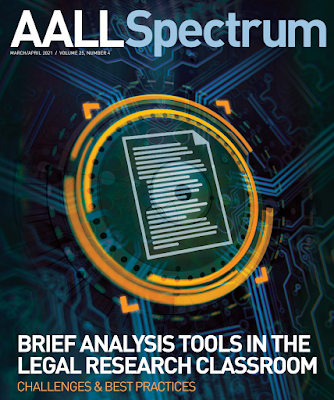
March/April 2021 Issue of AALL Spectrum

The March/April 2021 issue of AALL Spectrum is now available online.

It is a publication of the American Association of Law Libraries.

Among the articles:

  • Using Social Styles in the Time of Social Distancing
  • Bridging the Gap Between Public Libraries & Law Libraries to Improve Access to Justice
  • Ask A Director (about how COVID-19 has impacted training)
  • On the Ground: Real-World Solutions (writing letters of recommendation)
  • COVID-19: How Did Your Staff Respond to the Pandemic?

Labels: , , , , , ,

Bookmark and Share Subscribe
posted by Michel-Adrien at 7:01 pm 0 comments

Thursday, August 27, 2020

September/October 2020 Issue of AALL Spectrum

Bookmark and Share Subscribe
posted by Michel-Adrien at 8:41 pm 0 comments

Monday, January 27, 2020

CanLII Publishes Instructional Materials from CALL Members

The Canadian Legal Information Institute (CanLII) has published a series of instructional materials produced by members of the Canadian Association of Law Libraries (CALL). They show how to use the CanLII website for legal research.

There are materials on:
  • How to Browse Legislation
  • How to Limit Search Results Using Filters
  • How to Browse Commentary
  • How to Search Commentary
  • Using Commentary
As this CanLII blog posts explains:
"This time last year, the CanLII team asked Canadian Association of Law Libraries (CALL) members to produce instructional materials to assist users on how to use CanLII."

"We were pleased to learn that there was immediate interest from CALL members when a call for volunteers was announced. Since then, a motivated working group was formed and we have received content in the form of visual aids and handouts."

Labels: , ,

Bookmark and Share Subscribe
posted by Michel-Adrien at 4:45 pm 0 comments

Tuesday, January 22, 2019

Canadian Association of Law Libraries Needs Volunteers to Create Content for CanLII

The Legal Research and Writing Special Interest Group of the Canadian Association of Law Libraries (CALL) is creating a working group to create content for the Canadian Legal Information Institute (CanLII).

CanLII would like CALL members to produce a minimum of eight instructional materials per year, particularly visual aids to assist users in understanding how to use CanLII (e.g., videos, infographics, etc.).

In exchange, CanLII will pay CALL $1000 per year for the non-exclusive right to publish the content on CanLII’s websites and social media accounts. Content creators would retain copyright or their work and receive proper attribution.

Interested CALL members can fill out this Google form and the people who run the Legal Research and Writing group will get in touch.

Labels: , ,

Bookmark and Share Subscribe
posted by Michel-Adrien at 7:50 pm 0 comments

Tuesday, June 19, 2018

2018 Legal Research Teach-In Toolkit from American Association of Law Libraries

The Research Instruction and Patron Services Special Interest Section (a sub-group of the American Association of Law Libraries) has released its 26th Annual National Legal Research Resources Kit.

Every year, the Section solicits contributions from the law library community that other librarians can use to develop their own instructional activities at their institutions.

This year, there are submissions that include games, course and presentation materials, infographics and more.

The Canadian Association of Law Libraries (CALL) has an Instructional Resources Bank in the members-only section of the CALL website.

Labels: , ,

Bookmark and Share Subscribe
posted by Michel-Adrien at 4:37 pm 0 comments

Sunday, May 27, 2018

Canadian Association of Law Libraries 2018 Conference - Additional Annual Reports

This is a follow-up to the post entitled Canadian Association of Law Libraries 2018 Conference - More Annual Reports.

The Canadian Association of Law Libraries (CALL) started its 2018 annual conference this morning in Halifax.

In preparation for the event, committees and special interest groups (SIGs) have submitted their annual activity reports.

Here are a few extra ones I missed last week:
  • Academic Law Libraries SIG: one of the SIG's initiatives this past year involved the compilation of a Hate Crimes FAQ. This was related to concern expressed during a teleconference of SIG members about hate crimes on university campuses. The SIG is also partnering with the Legal Research and Writing (LRW) SIG on the creation of teaching videos for LRW and Indigenous collections in academic law libraries. Finally, it will start work on compiling a list of institutional activities or initiatives being undertaken in response to the recommendations of the Truth and Reconciliation Commission on Indian residential schools
  • Legal Research & Writing SIG: the SIG has reached out to its membership to coordinate the collection of assignments, reference materials, research guides, and other teaching resources that instructors/professors would like to contribute to the Instructional Materials Bank available through the members only section of the CALL website
  • New Professionals SIG (see resources associated with this SIG on the CALL SIGs page): this SIG supports student members of CALL as well as new professionals in the first years of their law librarianship career. At the 2018 conference, it is sponsoring a panel discussion entitled "Taking the ‘Work’ Out of Networking: Build Relationships, Not a Stack of Business Cards". The SIG, one of CALL's most active with some 40 members, runs a listserv hosting monthly forum discussions on professional development opportunities, awards and scholarships, and other developments in the legal information profession

Labels: , , , , , ,

Bookmark and Share Subscribe
posted by Michel-Adrien at 1:06 pm 0 comments

Friday, March 09, 2018

Registration Now Open for 2018 WILU Library Instruction Conference in Ottawa


WILU stands for Workshop for Instruction in Library Use and is an annual Canadian conference devoted to research and innovations in the area of information literacy and library instruction.

The University of Ottawa Library will be hosting the 2018 WILU conference next June.

Registration is now open.

The WILU 2018 conference site has a history section that contains presentations from many earlier gatherings.

Labels: ,

Bookmark and Share Subscribe
posted by Michel-Adrien at 2:11 pm 0 comments

Wednesday, October 04, 2017

Call for Proposals for WILU 2018 Library Instruction Conference in Ottawa

WILU stands for Workshop for Instruction in Library Use and is an annual Canadian conference devoted to research and innovations in the area of information literacy and library instruction.

The University of Ottawa Library will be hosting the 2018 WILU conference next June.

The Call for proposals is open until November 13, 2017.

Proposals can be made for the following formats:
  • Presentation (45-minute session)
  • Workshop (120-minute session)
  • Panel discussion (45-minute session)
  • Lightning talk (7-minute session)
  • Techno expo kiosk (similar to a poster session, but with computers and large screens to showcase innovative applications of instructional technology)
The WILU 2018 conference site has a history section that contains presentations from many earlier gatherings.

Labels: ,

Bookmark and Share Subscribe
posted by Michel-Adrien at 3:51 pm 0 comments

Sunday, May 14, 2017

Demystifying Legislation Talk at the Canadian Association of Law Libraries 2017 Conference

The Canadian Association of Law Libraries (CALL) finished its 2017 annual conference in Ottawa last Wednesday.

One of the talks I attended was entitled "Demystifying Legislation: Drafting and Research" and featured three speakers who discussed how federal legislation comes about and how to research legislative intent.

The three speakers were:
  • Aleksander Hynna, legal counsel at Justice Canada
  • Wendy Gordon, House of Commons Law Clerk Office
  • Emily Landriault, University of Ottawa
Hynna described the often complex process that leads to the presentation of government bills in Parliament.

Many players are involved: Cabinet, political staff, Justice department legal counsel and jurilinguists, departmental subject matter experts, etc.

One interesting detail was the care with which those involved try to ensure that drafts in English and in French take into account legal issues and vocabulary from both the common law and civil law traditions. Drafts have to be truly blingual and bijural. English and French legislative drafters receive the same instructions and each drafts a version of the bill in light of what the colleague from the other language is creating. The process is not one of translation but rather of "co-drafting".

Hynna was able to give attendees the feeling of being inside the drafting room (an actual office space). He described in detail what he calls the back-and-forth "drafting shuttle" with drafts going back to departments and experts for comments which then get incorporated into newer versions, etc.

Gordon explained the process of drafting private members bills, bills sponsored by backbenchers which are not official government legislative proposals.

In the previous (41st) Parliament, 503 private members bills were introduced in the House of Commons. 34 made it all the way through Parliament and received royal assent. Most died on the order paper, Some 58 actually made it far enough in the debates but were defeated.

According to Gordon, royal assent is not the only measure of success. Often, bills are introduced to allow local constituents to have a voice in the political process, to spark debate, to put the parties on official record on a controversial issue, etc.

One important fact Gordon stressed is that her office, which is in charge of drafting private members bills, takes its role very seriously despite the low odds of success.

Contrary to government bills, private members bills are written in one language and translated. Research input comes from the Library of Parliament. MPs can ask for help on any topic within obvious limits: is the matter federal? does it comply with the Constitution? is there a similar bill on a similar topic in front of Parliament? As well, a private members bill can not raise money.

Drafting is done on a first come first served basis but not all bills are equal when it comes to them being introduced in the House. Priority is based a raffle or draw to establish an "order of precedence" for presentation in Parliament.

Finally, Landriault outlined the various sources for finding the intent being federal legislation. This is more familiar territory for any Canadian law librarian. She described sources such as government websites for backgrounders, the LEGISinfo parliamentary site for more recent bills as well as online parliamentary materials such as Hansard and committee reports and evidence. For earlier bills, print Hansard and print committee documentation are part of the law librarian's tool kit.

She did draw attention to the less well-known RIAS that help determine background for regulations. RIAS stands for the "regulatory impact assessment statement", a backgrounder that accompanies proposed regulations published in the Canada Gazette pt. I and official versions of new regulations published in the Canada Gazette pt. II.

Labels: , , , , ,

Bookmark and Share Subscribe
posted by Michel-Adrien at 8:18 pm 0 comments

Wednesday, May 10, 2017

Lightning Talks at the Canadian Association of Law Libraries 2017 Conference

The Canadian Association of Law Libraries (CALL) finished its 2017 annual conference in Ottawa earlier today.

I will report on some of the educational sessions later this week but I want to draw attention to a conference favourite (aside from all the social events and get togethers where legal information professionals from across Canada and abroad can network and exchange info).

I am referring to the so-called Lightning Talks, a series of quick presentations on an issue, a technology, or a project (maximum of 7 minutes).

In a hour or an hour and half, attendees are offered an overview of the creativity and passion of their colleagues, a very busy bunch of professionals indeed.

There were 8 Lightning Talks this year :
  • John Kerr (Wellington Law Association) talked about Raspberry Pi as Public Access Terminal: Raspberry Pi is a low-cost computer the size of a deck of cards that is Linux-based, network-ready, and low-energy that can be used as a cheap public terminal.
  • Alan Kilpatrick (Law Society of Saskatchewan) described library Access to Justice projects in that province. These include expanded access to the province's caselaw on the free CanLII website; the Pro Bono Librarians group that provides free research assistance to pro bono lawyers; a weekly free family law clinic in Regina (now starting in other cities); and a partnership between libraries and public legal education associations to ensure that the public can access reliable up-to-date legal information.
  • Hannah Steeves (Dalhousie University) talked about the use of a flipped classroom model to teach legal research and writing classes. In a flipped classroom, students read or watch lecture materials beforehand and then spend classtime in active hands-on work.
  • John Miller and Josee Daris of DOCIP (the Indigenous peoples’ Centre for Documentation, Research and Information, Geneva) described the structure and services of their institution.
  • Fiona McPherson (Justice Canada) introduced attendees to "The Neutral Zone" style of meeting described as "a safe haven, a place to comment, talk, question and unload, which will carry no repercussions after the meeting is over."
  • Channarong Intahchomphoo (University of Ottawa) showed the emojis the university law library created as a way of engaging in a more fun way with students on chat and other social media apps.
  • Greg Wurzer (University of Saskatchewan) explained how he worked with an instructional designer to create online modules to teach Canadian legislative research. 
  • finally Veronika Kollbrand (University of British Columbia) explained how the CALL Special Interest Group for library students, the Student SIG, transformed into the New Professionals SIG with a broader mandate and an already growing membership including both students, law librarians in the early stages of their career and mentors.

Labels: , , , , , , , ,

Bookmark and Share Subscribe
posted by Michel-Adrien at 7:55 pm 0 comments

Tuesday, May 09, 2017

Canadian Association of Law Libraries 2017 Conference: More Annual Reports & Meetings

This is a follow-up to the Library Boy post of May 4, 2017 entitled Canadian Association of Law Libraries 2017 Conference Annual Reports.

The Canadian Association of Law Libraries (CALL) has been holding its 2017 annual conference in Ottawa since the weekend.

I will report on some of the educational sessions later this week, but an important part of the event involves the meetings of CALL committees and special interest groups.

Here are summaries of some of the annual reports submitted and of meetings I attended.

Canadian Abridgment Editorial Advisory Committee
The Canadian Abridgment is a topical compilation of Canadian case digests produced by Carswell (Westlaw Canada). The Board, composed of 7 CALL members, meets twice a year with the editorial staff of the Canadian Abridgment.

According to the Committee, the Criminal Law volumes will be reissued by the end of 2017. For those libraries still collecting the print edition, this will require a major consideration for space requirements as this reissue is projected to be 54 volumes. This is partly due to the consolidation of Carswell and Canada Law Book content from Criminal Reports and Canadian Criminal Cases.

Carswell is planning some additional changes to make the Abridgment more prominent in WestlawNext Canada. For example, the “Related Abridgment Classifications” box will be open by default on case law documents; and users will be able to filter search results by Abridgment classification as well as subject area filters.

The Index to Canadian Legal Literature recently added the Toronto Law Journal, as well as articles from Relations industrielles/Industrial Relations. The editorial policy was also updated recently to start adding blogs to the index, starting with thecourt.ca.

Courthouse & Law Society Librarians Special Interest Group (SIG)
I attended this meeting on Sunday morning. Attendees discussed three topics: preservation issues; proving the value of the library; and improvements to CanLII (Canadian Institute for Legal Information).

How to prove the value of the law library sparked a lot of discussion. Some participants suggested looking to models such as the American Library Association's Library Value Calculator (that would need to be adapted to the law library context) as well as to the template for gathering statistics on the LibraryCo website (Ontario courthouse library network). Others argued that satisfaction surveys and focus groups could produce good results. It was also suggested to take a page from the Day in the Life (of a library) project and recruit CALL members to document everything they accomplish on one specific day to be determined.

The SIG will work to develop a series of tools to help members show their value to funders and stakeholders. In 2010, the SIG had published a document on Best practices for demonstrating the value of your library services. It is a good point of departure but would need to be updated.

 Membership Development Committee meeting
I summarized the committee's annual report in an earlier post. Attendees at the committee meeting on Sunday started a discussion on a strategic plan for the next year that would involve more energetic reaching out to less active members (current members not involved in a committee or SIG, new members who have not attended an annual conference in a certain period, lapsed members).

Various mechanisms can be explored (phoning, e-mail, discussion forums, Twitter chats) to find out what services are valuable to members: salary surveys, further engagement on developing professional competencies, resources specific to the life cycle of a law librarian, etc.

It will also look into gathering and publicizing member testimonials on how CALL has helped them in various ways as well as mentor/mentee testimonials as a way of promoting the value of the association.

Website Editorial Board (WEB)
Members of the WEB discussed what kinds of additional content can be produced or repurposed for the website.
  • Many CALL members probably have already read that the association's Canadian Law Library Review will become an open and free access journal which means moving the electronic versions from the member’s only section of the CALL website to the public area that all visitors can access. The details need to be worked out but the CALL Executive has agreed to this change.
  • Attendees also agreed to look into creating a brief section with information about the history of CALL as well as an advocacy section to gather together and highlight CALL's official statements and position papers on issues such as copyright and other public policy issues.
  •  They also discussed many other long-term ideas such as creating an index to previous conference proceedings (if feasible), making the association archives held at the University of Manitoba more visible/findable, and seeing what the WEB can do to help those SIGs and committees that have made known their intention to create new content. For example, the Legal Research & Writing SIG has started compiling an Instructional Resources Bank (CALL members only section)

Labels: , , , , , , ,

Bookmark and Share Subscribe
posted by Michel-Adrien at 5:39 pm 0 comments

Sunday, April 23, 2017

May/June 2017 Issue of AALL Spectrum

Bookmark and Share Subscribe
posted by Michel-Adrien at 4:42 pm 0 comments

Saturday, March 04, 2017

Using YouTube for Teaching Legal Research

In late February, we hosted a focus group at my place of work to ask staff lawyers what they thought of our library reference services.

One of the questions had to do with our ongoing program of "Tips and Tricks" training sessions.
Once a month, we organize quick 15-20 minute meetings where we show how to research a topic (public international law, Quebec Civil Code, criminal law, UN Treaties, etc.).

We demo databases or websites and prepare a nice, clean, readable PDF handout for attendees. We also publish all our training PDFs on our library Intranet. We have created a few dozen topical handouts so far.

But the lawyers at the focus group became very excited when one attendee suddently suggested that everything be available on demand in audiovisual format, a sort of "library Netflix".

Well, this week, by chance I came across the YouTube channel created by the Education and Reference Department of the Boston College Law Library.

The channel includes many videos related to topical legal research courses offered at the College. Quite impressive.

I wonder if any Canadian law libraries have created online training videos like these.

Labels: ,

Bookmark and Share Subscribe
posted by Michel-Adrien at 4:24 pm 0 comments